

PROJECT MANAGEMENT 101 AT WESTON & SAMPSON
MODULE 2 · WEEK 4
BUILDING THE WBS FROM THE PROPOSAL
NOT READY FOR REVIEW
Approximate reading time: 10 minutes
After award, the proposal is the record of what our firm agreed to deliver to the client. The project manager builds the Work Breakdown Structure from it and then manages the work of the team from it.
Lesson 2.3 defined the Work Breakdown Structure as a core component of the Scope of Services and a foundational element of the project plan. This lesson teaches how to create the WBS.
This lesson covers four subjects:
The documents a project manager collects before the build,
The six steps that build the structure with the disciplines,
The two direction check against the scope of services, and
The team review that completes the structure.
MODULE 2 PURPOSE AND SCOPE
Module 2 covers scope development, the step that turns a winning approach into work our firm can deliver and defend. Participants learn how Weston & Sampson writes a scope of services, tests it, states its assumptions and exclusions, and organizes the same work into a Work Breakdown Structure.
WHERE THIS FITS
Module 0 · The Business of Weston & Sampson
Module 1 · Project Pursuit
Module 2 · Scope Development
Week 1 · Writing the Scope of Services
Week 2 · Assumptions and Exclusions
Week 3 · The Work Breakdown Structure
Week 4 · Building the WBS from the Proposal (you are here)
Module 3 · Schedule
Module 4 · Budgeting and Project Economics
Lesson objectives
After completing this lesson, a project manager will be able to:
- Collect the awarded proposal, the agreement, and the discipline scopes, and identify what each document contributes to the structure.
- Build a Work Breakdown Structure in six steps.
- Check the structure against the scope of services.
- Review the completed structure with the project team.
2.4.1 What the project manager collects
A proposal, when executed, forms part of our legal agreement with the client. It is one of several inputs the project manager uses to build the .
The project manager reviews four documents before building the structure:
- The awarded proposal, which holds the and initial,
- The executed agreement, which holds the final scope with its and its ,
- The scope each discipline prepared during the pursuit, and
- Client documents and similar past scopes, which supply the detail a proposal summarizes.
The narrative scope is the starting document, but it is not sufficiently decomposed to plan from or to manage work from. This is where the project manager begins the development process.
Remember: The structure is built from the documents the client accepted. What the pursuit team intended and did not write down is not yet part of the work.
2.4.2 The six steps
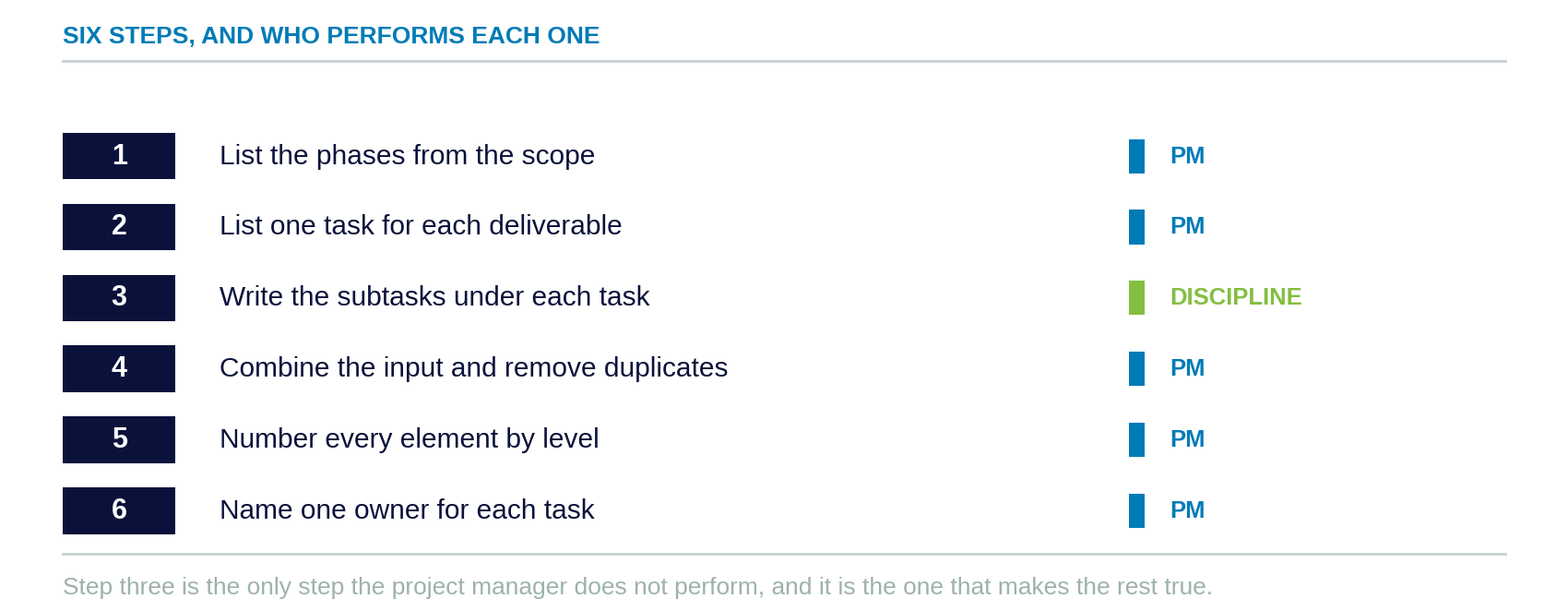
Building a strong is a collaborative process, led by the project manager, with input from the disciplines who wrote the scope. The process requires six steps.
2.4.2.1 Phases
The project manager first lists the from the . Phases of work define major milestones and billing containers. The language of the WBS should match the proposal / contract language exactly, so that the project manager, the team, and the accounting department can easily cross reference WBS elements to the proposal and to the billing process.
Depending on the proposal type, the phase naming convention can range from highly detailed and rigid to informal, running prose. The phases are defined by identifying the major points where a deliverable changes the stage of the project.
2.4.2.2 Tasks
The second step lists the under each phase. Typically, each task is defined as a deliverable or result produced in fulfillment of a specific scope item. A named phase with no task is a common gap to hunt for and identify here. Work that produces no deliverable can still produce a result, such as coordination with a utility owner. Tasks can exist even if the result does not produce something that leaves the office.
2.4.2.3 Subtasks
In the third step, each discipline prepares the under its own tasks. After the project manager has defined the Phases and the Tasks, the discipline leads itemize the specific elements of work that their staff will produce to satisfy the Tasks.
A WBS element stops at a subtask when three conditions are met:
- One discipline performs it,
- The team can estimate the hours it takes, and
- It has a defined end that somebody can observe.
The estimate condition carries the same test the scope of services uses. A subtask that is not sufficiently clear to estimate time and resources for is not yet a subtask.
A structure need only be as detailed as the project requires. Decomposing further produces elements nobody tracks, and the largest element that still meets all three conditions defines the end point.
The gives a practical floor. A subtask small enough to price there is appropriately sized to manage.
One more test settles most arguments about depth: read the subtask aloud and ask who would send the email that says it is finished.
If one person can send it, the element is the right size. If the answer needs two people from two disciplines, the element holds two subtasks and requires further decomposition.
Remember: Stop at the level where one discipline can be assigned, the hours can be estimated, and the finish can be observed.
2.4.2.4 Create the combined structure
The fourth step combines the discipline input into one structure and removes the duplicates. Duplicate removal prevents two disciplines from potentially describing, scheduling, and staffing the same work and simplifies future work management. Where two disciplines share outputs from a Task, the Subtasks define who does what.
2.4.2.5 Number every element by level
The fifth step numbers every element by level. A phase takes a whole number, a task takes one decimal place, and a subtask takes two. Those numbers become the reference that the schedule, the budget, and every progress conversation use.
2.4.2.6 Named owner
The sixth step establishes one owner for each task. The owner is the discipline responsible for completing the work. The person or people who will complete the work get assigned later. Where two disciplines both contribute the project manager splits the task rather than naming two owners.
Separate tasks by discipline wherever the work allows it. A task that carries two disciplines produces a single budget line that two people charge to, and neither one can tell from the report whether the task is over or under.
Remember: Each discipline writes its own subtasks and the project manager owns the structure that holds them. Neither job produces a usable structure alone.
2.4.3 The check in two directions
The and the describe the same work, and both are edited after they are written. A scope sentence changes during negotiation. A discipline adds a after a site visit. Neither edit reaches the other document by itself. Two passes confirm that the two still agree.
The reads each scope sentence and finds the element that performs it, and a sentence with no element is work our firm has promised that nobody has been assigned to perform.
The reads each element and finds the scope sentence that requires it, and an element with no sentence is work our firm plans to perform that the fee does not cover.
Neither pass finds what the other finds, which is why both are run, and the four gap types that come out of them each carry one action.
| The gap | What it means | The action |
|---|---|---|
| A scope sentence with no element | Promised work that nobody will perform | Add the element and name the owner |
| An element with no sentence, and an covers it | The scope already removed this work | Remove the element |
| An element with no sentence, and no exclusion covers it | The scope is silent and the fee does not cover it | Ask the client, and write an exclusion until the client answers |
| A sentence the team cannot break into elements | The sentence fails the Specific or the Finite question | Obtain the information, or write an |
2.4.3.1 An example
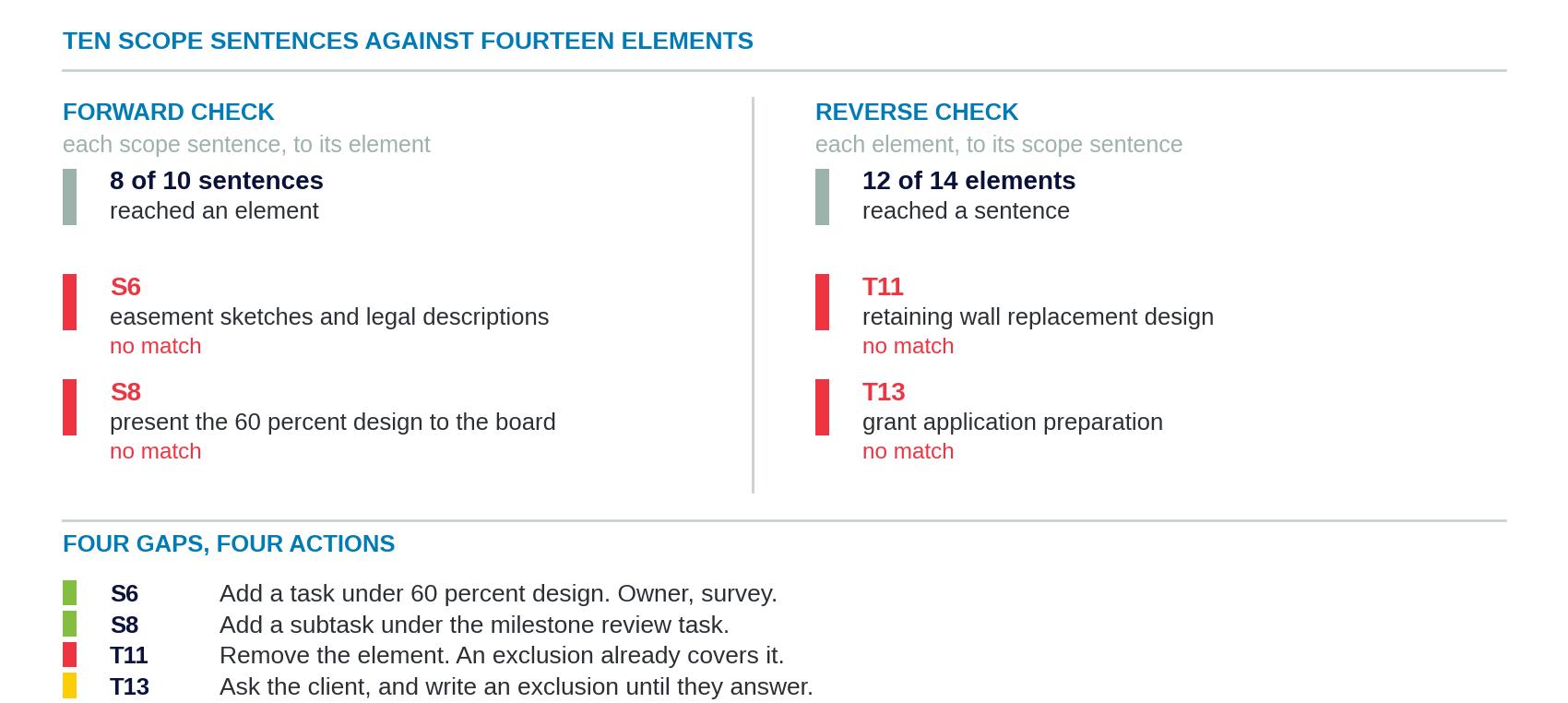
Consider a roadway and utility design with 10 scope sentences and 14 elements. The forward check traces eight sentences to an element and leaves two unmatched, and the reverse check traces 12 elements to a sentence and leaves two unmatched.
The first unmatched sentence commits our firm to prepare easement sketches and legal descriptions, and no element performs it, so the project manager adds a under 60 percent design and names the survey discipline as its owner.
The second unmatched sentence commits our firm to present the 60 percent design to an advisory board, and again no element performs it, so a subtask joins the milestone review task under the same .
The first unmatched element is a retaining wall replacement design, which an exclusionary statement in the agreement already removed. The project manager deletes the element and changes nothing else. The pursuit team had planned that work, the negotiation took it out, and the structure was built before anyone reread the executed agreement.
The second unmatched element prepares a grant application, and the scope says nothing about grants in either direction. The project manager asks the client, removes the element, and writes an exclusion that names our firm, names grant applications, and states that additional compensation applies if the work is added.
Remember: The forward check finds work with no plan. The reverse check finds plans with no work. A project that runs on one of the two checks is missing half of its gaps.
2.4.4 When a scope sentence cannot be decomposed
A sentence the team cannot break into elements has already failed a review question, but it still reaches a signed from time to time. The less specific the sentence is at the writing stage, the more difficult it becomes to resolve at the stage.
Three actions close it:
- Obtain the missing information from the client, and add the quantity to the scope sentence,
- Write an that states the condition, the quantity, and the result if the condition changes, and
- Write an exclusionary statement that removes the work from the scope.
The first action only works before signature. Once executed, a change to the scope of services requires an , negotiated before the work begins rather than after it. The structure is normally built after award, so the project manager works with the discipline leads to write the assumption or the the sentence needs, rather than reopen the scope.
Whichever action the project manager takes, both documents change together, or an element edited without its sentence puts our firm back where the check started.
Think of a project where the fee ran out before the work did. Ask one question about it. Was the work in the scope of services, and did the structure hold an element for it?
Three of the four answers point to a gap this lesson closes. Work in the scope with no element was unstaffed and unbudgeted. Work in neither was outside the fee from the start. Work in the structure with no scope sentence was performed at our own cost. Only work in both, underestimated, is an estimating problem rather than a scope problem.
2.4.5 The team review
The structure is reviewed with the project team before it is used. Every discipline gives input and owns the result, which is the same standard our firm applies to a project budget. A who reads the for the first time at the 60 percent milestone has been given a schedule rather than a plan.
Three things are confirmed in that review:
- Each discipline has read the subtasks it will perform and accepts them,
- Each carries one owner, and
- The and tasks are ready to open on the .
The project manager reviews the scope of work again at the internal kickoff meeting, with the people who will perform it in the room, and the completed structure is what makes that review specific. A kickoff that walks the numbered elements produces different questions than one that describes the project. A person looking at an element with their own discipline on it reads it differently.
Two modules build directly on this structure. Module 3 sequences its elements into a schedule, and Module 4 assigns staff and cost to the same elements.
Remember: A structure the disciplines have read is a plan. A structure the project manager wrote alone is a forecast of what one person expects other people to do.
2.4.6 Summary
The project manager collects the awarded proposal, the executed agreement, the discipline scopes, and the client documents, and builds the structure in six steps. Each discipline writes its own , and the project manager combines them, numbers them, and names one owner for each .
Two checks confirm the result. The finds a scope sentence with no element, and the finds an element with no scope sentence. Each gap closes with an element, an , an , or a question to the client, and both documents change together.
Module 2 answered one question in four lessons. Lesson 2.1 wrote the work down for the client and tested the language. Lesson 2.2 stated the conditions and the limits, and Lesson 2.3 organized the same work for the team. This lesson confirmed that the two answers agree.
The work is now defined, owned, and bounded, and what remains is to sequence it. Module 3 covers how a project manager turns this structure into a schedule the team can work to and the client can hold our firm to.
Remember
- The structure is built from the documents the client accepted. What the pursuit team intended and did not write down is not yet part of the work. Section 2.4.1
- Stop at the level where one discipline can be assigned, the hours can be estimated, and the finish can be observed. Section 2.4.2
- Each discipline writes its own subtasks and the project manager owns the structure that holds them. Neither job produces a usable structure alone. Section 2.4.2
- The forward check finds work with no plan. The reverse check finds plans with no work. A project that runs on one of the two checks is missing half of its gaps. Section 2.4.3
- A structure the disciplines have read is a plan. A structure the project manager wrote alone is a forecast of what one person expects other people to do. Section 2.4.5