

PROJECT MANAGEMENT 101 AT WESTON & SAMPSON
MODULE 1 · WEEK 2
THE GO/NO-GO DECISION
Approximate reading time: 11 minutes
Module 0 established the economic model every project supports.
Week 1 described how new work enters our firm, from lead through opportunity to award.
This lesson covers the Go/No-Go decision our firm makes before committing meaningful time and resources to a pursuit.
Because our firm pays for proposal hours, bills none of them, and absorbs the cost in overhead, the Go/No-Go decision is a critical business decision we make on every opportunity.
This lesson covers four subjects:
How owners select professional services firms, and their criteria.
When a Go/No-Go is required, and how the form reaches a recommendation.
The evidence the form requires, and what a Go decision produces.
The form structures the evaluation using qualitative and quantitative data, consideration of our firm’s strategic priorities, and judgment by the pursuit team.
MODULE 1 PURPOSE AND SCOPE
Module 1 covers the pursuit, the period before a project exists. Participants learn how Weston & Sampson identifies, evaluates, prices, and records an opportunity. They also learn how those decisions affect value for the client and for our firm. Three companies make up Weston & Sampson, and this course addresses the engineering company only.
WHERE THIS FITS
Module 0 · The Business of Weston & Sampson
Module 1 · Project Pursuit
Week 1 · The Pursuit, from Lead to Award
Week 2 · The Go/No-Go Decision (you are here)
Week 3 · Pursuit Roles and the Opportunity Record
Week 4 · The Proposal Kickoff Meeting
Module 2 · Scope
Module 3 · Schedule
Module 4 · Budgeting and Project Economics
Keep the Go/No-Go form available while reviewing this lesson.
Lesson objectives
After completing this lesson, a project manager will be able to:
- Describe how an owner selects a design consultant and explain how we judge our firm's position against those qualification criteria.
- Analyze a request for proposals for both required and unstated criteria.
- Complete the Go/No-Go form for a fictional opportunity.
- Record the pursuit information a Go decision requires and produce a defensible recommendation.
1.2.1 Where the Go/No-Go decision sits
The Go/No-Go process is positioned early in the Initiating Process.
The Initiating Process
The decision to commit proposal hours happens here, before any fee exists.
1.2.2 How clients select design consultants
Our firm receives requests for services through three general procurement types, listed in decreasing formality:
- (RFQ). The owner selects a consultant on qualifications alone and negotiates scope and fee with the awarded firm afterward.
- (RFP). The owner requests qualifications, scope, and fee in one document, which the proposal sets at submission, and selects the consultant from this document.
- . The request arrives outside any formal solicitation, usually from a client our firm already serves. Such solicitation may include no published selection criteria and may come only to us (“”) or to a limited number of individually selected competitors.
A direct appeal carries a higher , because the decision relies more heavily on past relationships and capacity.
The following sections walk through common selection criteria that are outlined visually in Figure 2.
1.2.2.1 Minimum evaluation criteria
On most projects, are pass or fail requirements that we must verify we meet to propose. These often include things like:
- in the project state,
- Insurance limits,
- Mandatory experience thresholds,
- Location, and
- Firm business registration.
A submission must satisfy all of them, because a submission that fails any minimum evaluation criterion is treated as non-responsive.
1.2.2.2 Comparative evaluation criteria
are used to rank the competing firms and are weighted per the solicitation’s requirements. Common comparative evaluation criteria may include:
- Relevant project experience, problem understanding, and technical approach,
- Team availability and qualifications, experience working together, past performance, permitting familiarity, local responsiveness, and small business subcontracting, and
- The requested fee.
How an owner selects a design consultant
Solicitation issued
A request for qualifications or a request for proposals defines what the owner will evaluate.
Minimum criteria applied
Pass or fail. Licensure, insurance, mandatory experience, and submission requirements.
Comparative criteria scored
Ranked. Experience, team, understanding, approach, past performance, and local presence.
Short list and interview
The owner narrows the field and tests the team in person.
Selection, then fee
Fee is negotiated after selection unless the solicitation required a fee up front.
Question 1 of the Go/No-Go form asks about both sets of criteria at once.
Take a solicitation you read recently. What did the owner say it would evaluate, and at what weight?
Some owners publish specific evaluation criteria, and they are easy to skim past. Read them closely and answer Question 1 on the Go/No-Go from evidence.
1.2.3 Reviewing the request for proposals
Read the in its entirety before any other step, because the requires the person completing it to confirm that they have done so.
Record the time available until the response is required. Marketing cannot guarantee support with less than a two-week .
Review the solicitation twice. Each review is focused on determining specific items that Weston & Sampson evaluates in the Go/No-Go form.
1.2.3.1 Stated requirements
The first review records the six stated requirements our firm must deliver to remain responsive:
- The the client will score, which Marketing copies into the .
- The minimum and , and the professional licensing the project state requires, since missing a minimum criterion is an .
- The , including page limit, font size, format, number of copies, delivery method, and any required forms or portal submittals.
- The dates, including the date questions are due, the submission date and time, and how the client issues .
- The contract terms and insurance requirements, which go to Risk Management before submittal and cannot be negotiated after award.
- Any (DBE) goal or teaming requirement.
1.2.3.2 Unstated conditions
The second review identifies what the document omits. Four conditions are normally absent, as shown in the figure below:
- The reason the work is necessary, which may be a new permit limit, a failed inspection, a council vote, an expiring grant, or a host of other possibilities.
- The risks the client most wants to avoid, and where our firm’s experience can reduce those risks.
- The other parties who influence the selection, including operators, finance staff, a board, and/or a procurement consultant.
- The budget the client has established, which exists whether or not the RFP states it.
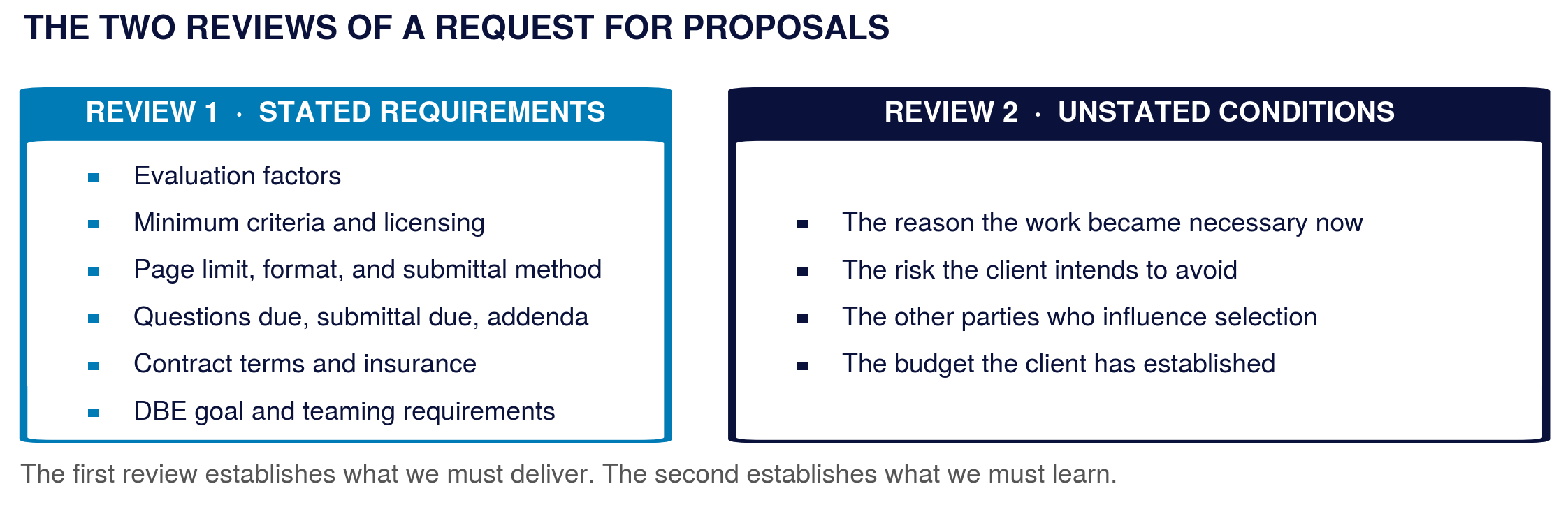
Remember: The first review establishes what our firm must deliver. The second establishes what our firm must learn to win the work.
1.2.4 The Go/No-Go form and how to use it
A Go/No-Go is required when a pursuit requires a formal submission with support from Marketing. The uses 15 questions grouped into three categories to evaluate an opportunity:
- Two questions that can hard stop the pursuit,
- Twelve scored questions, and
- One area to record project context.
1.2.4.1 Section A, the qualification minimums
Section A has three questions, two of which act as a gate that stops a pursuit outright:
- Question 1, which states that “we meet all the minimum and .”
- Question 2, which states that “we can commit the time and attention to complete the proposal within the agreed upon schedule and be responsive throughout the process.”
A No answer to either question is an , which ends the evaluation. The final step is to record the result of the evaluation in . When the is updated to No-Go or , Deltek Vantagepoint inactivates the opportunity automatically.
Question 3 asks whether our firm has licenses for all required services in the project state. It is worth 10 points. A “No” lowers the total final score but does not stop the pursuit.
1.2.4.2 Sections B through D, the scored questions
Questions 3 through 14 are scored to a maximum of 100 total points. Questions 4 through 14 are organized into three sections as indicated below.
| Section | Points | What it tests | Evidence to examine |
|---|---|---|---|
| B. Strategic Fit and Positioning | 60 | Whether our firm can win | , project awareness, client relationship, competitor differentiation |
| C. Profitability and Resources | 10 | Whether the fee supports profitable delivery | Scope, staffing, schedule, subconsultants, risk |
| D. Operational Readiness | 20 | Whether our firm can mobilize | Regional experience, local staff, market position, staff capacity and capabilities |
Question 14 (We should submit even if the G/NG score is lower than 70) applies only below 70 points. Question 15 records an emerging market or location for no points.
1.2.4.3 Reading the score
Work through each question. Carefully consider what it asks and provide a point value response based on the nature of the question and the scoring criteria. Once complete, read the total in the sequence the figure shows:
- Tabulate the total score out of 100.
- At 70 or higher, the Go recommendation proceeds to final review.
- Below 70, answer Question 14 and record a written reason for any Yes.
How the form reaches a recommendation
Questions 1 and 2
Two automatic No-Go questions
Questions 3 to 14
Scored. 100 points available
Score 70 or higher
Recommendation proceeds
Any No answer
Stop. Record the reason
Score below 70
Answer Question 14, or No-Go
Question 15 records context only. The score never overrides an automatic No-Go answer.
Work it through. An opportunity clears both automatic No-Go questions and scores only on licensure (10), a capture plan (10), a client relationship (10), and regional experience (10). What is the total, and what follows?
Remember: The two automatic No-Go questions decide whether our firm may pursue the work. The remaining scored questions describe how well our firm is positioned to win.
1.2.5 The logic behind every answer
The form does not ask how the team reached its answers, so two teams can reach different totals on the same opportunity.
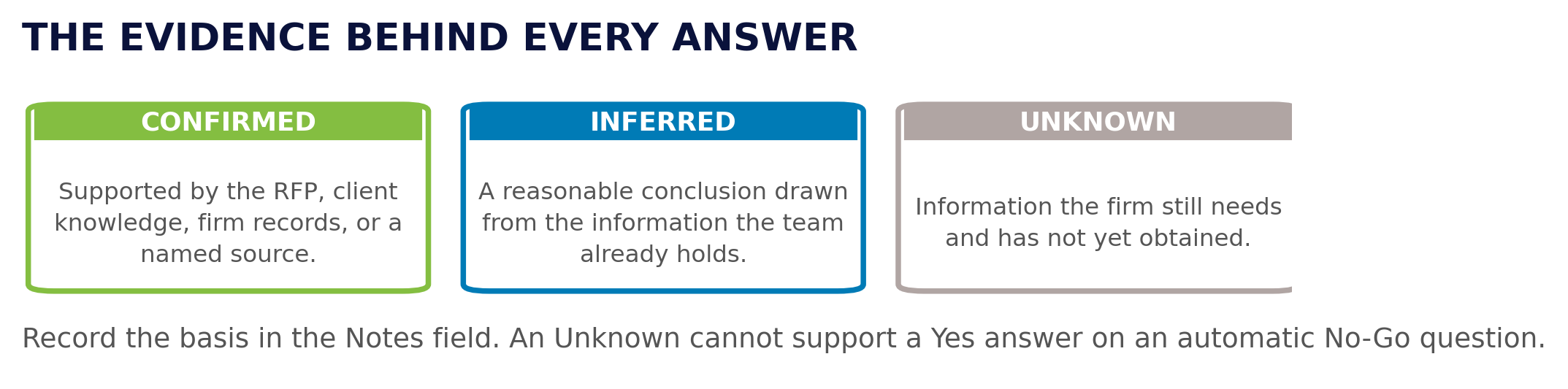
Before an answer is selected, the team should consider the basis behind each answer using one of three options:
- , from a named source,
- , from experience or comparison, or
- , from no evidence the team can name.
1.2.5.1 Who supplies the evidence?
No one person holds all the evidence, so evaluation may draw information from multiple available roles below.
| Role | What the role supplies |
|---|---|
| Develops the pursuit and holds its history. | |
| Client insight, introductions, competitor analysis. | |
| Technical approach and available hours. | |
| Staff availability and proposal pricing. | |
| Regional rates and expectations. | |
| Proposal strategy, schedule, and production. | |
| Signs the proposal, binding scope, schedule, and fee. |
1.2.6 Fit with firm strategy
Week 1 established that our firm plans against future workload projections that combine (the remaining on work under contract) with (“future backlog”) to create a composite picture of likely future conditions. A consistent and accurate method for creating these planning inputs is critical. Sometimes, we have projects that are valuable to our firm for other reasons, even though they fall outside our standard evaluation criteria.
Some work is worth more to our firm than its fee justifies. Such work could become a reference in a named initiative, deepen a targeted client relationship, or open a region our firm intends to grow. All are important considerations to our firm’s long-term performance, and even small projects can contribute to them. The form uses three scored questions to assess these strategic domains:
- Question 4 asks whether a business or exists for the practice area or client, worth 10 points.
- Question 8 asks whether our firm has targeted this client for ongoing work, worth 10 points.
- Question 9 asks whether the project relates to a , worth 10 points.
Together those three questions are worth 30 of the 100 points, meaning Weston & Sampson takes the strategic value of projects seriously. A technically simple and profitable opportunity can score the same on the as a complex and less profitable opportunity based on the answers to these questions.
Take an opportunity your group is pursuing and name which of the three strategic questions it satisfies.
Remember: Thirty of the 100 points measure strategic direction, showing that the form evaluates both whether our firm can do the work and whether it should.
1.2.7 The pursuit information a Go decision produces
A produces eight pursuit information fields:
| Field | What it records |
|---|---|
| One person, named and committed. | |
| Manager support | Regional or . |
| From the . | |
| Probability of winning the work | From the Deltek Vantagepoint OPP tab. |
| Estimated cost. For reference, the 2024 average was 35 technical hours spent on each proposal. | |
| capacity | Available before the deadline. |
| Proposal format | Word or InDesign. |
| Marketing hours | Estimated by Marketing. |
1.2.7.1 An example
Consider the following opportunity that passes through the complete Go/No-Go process.
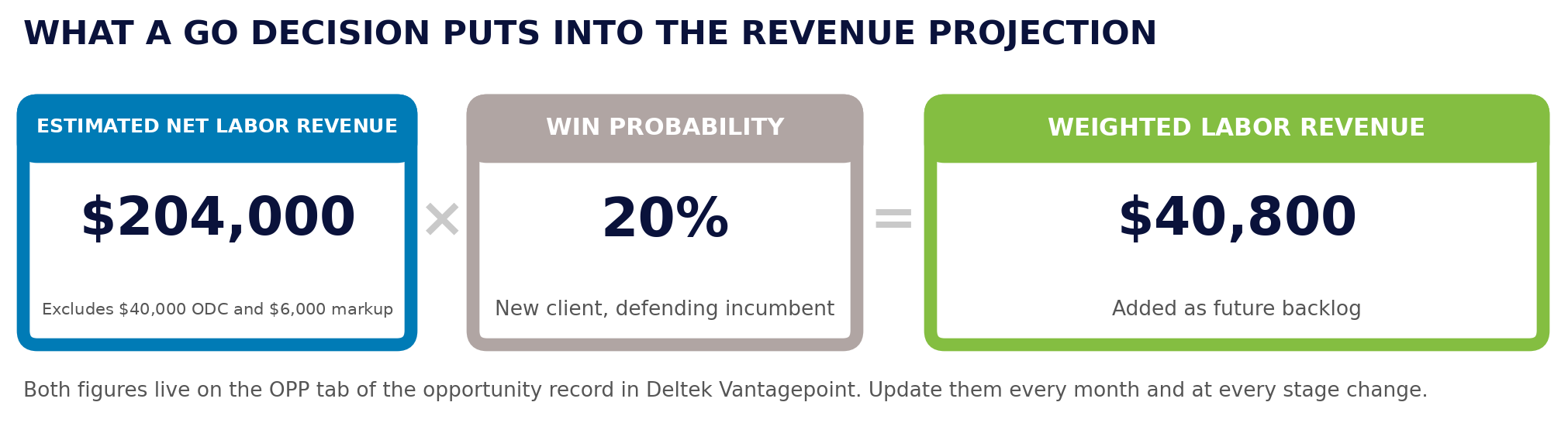
A municipal client issues an . The pursuit team reviews the solicitation and estimates a of $250,000. A subconsultant is required and their fee is estimated to be $40,000. With a 15 percent of $6,000, the client pays $46,000 for the subconsultant’s work. Weston & Sampson’s Estimated is $204,000, the revenue our firm estimates from its own staff alone. Our firm keeps the $6,000 markup, but the markup is not labor revenue, so it stays out of the projection.
The Technical Champion estimates 40 technical proposal hours and verifies that they are available before the deadline to spend this time on the proposal. The agrees to support the pursuit and Marketing estimates its hours for the requested InDesign submission, which was noted in the .
The team completes the Go/No-Go Form with a score of 80. The client is new and has historically used a local competitor, so the team estimates a 20 percent . That produces $40,800 of , which enters the as future backlog. The $6,000 markup is not multiplied by the win probability. The project manager estimates as weighted labor revenue, the win probability multiplied by Estimated Net Labor Revenue. The project manager records these figures in the in Deltek Vantagepoint.
1.2.7.2 Weighing the hours against the return
The opportunity above commits 40 technical proposal hours for $40,800 of weighted labor revenue. To test that investment, convert the technical and marketing proposal hours to raw cost and compare the total with the target of 3 to 5 percent of total project value covered in Week 4. That comparison is an important data point, but it must not decide the pursuit alone. A pursuit that costs more than the target may still be worth the cost when it opens a targeted client. The project manager should seek to balance these two considerations, investment vs. potential return, for each opportunity.
Remember: A Go decision ends when the team records the pursuit information in the system of record.
1.2.8 When No-Go is the right answer
Three conditions produce a No-Go regularly:
- Our firm needs a license in the project state and cannot obtain one in time.
- The solicitation requires experience our firm cannot demonstrate.
- The has multiple competing, higher priority opportunities or projects in the same response period.
Our firm recognizes that we will not win every project, and No-Go exists as an option on purpose. A No-Go helps concentrate proposal effort on opportunities our firm can win and that support our strategic direction.
1.2.9 Summary
The Go/No-Go process determines whether Weston & Sampson can pursue an opportunity, is positioned to win it, and should invest the required proposal resources. The team reviews the solicitation, tests the opportunity against qualification, strategic fit, profitability, and operational readiness, and supports each answer with evidence. A Go decision is not complete until the team records the resulting ownership, revenue, , capacity, and proposal requirements in the firm’s .
Week 3 explains how the pursuit team develops and maintains that .
Remember
- The first review establishes what our firm must deliver. The second establishes what our firm must learn to win the work. Section 1.2.3
- The two automatic No-Go questions decide whether our firm may pursue the work. The remaining scored questions describe how well our firm is positioned to win. Section 1.2.4
- Thirty of the 100 points measure strategic direction, showing that the form evaluates both whether our firm can do the work and whether it should. Section 1.2.6
- A Go decision ends when the team records the pursuit information in the system of record. Section 1.2.7