

PROJECT MANAGEMENT 101 AT WESTON & SAMPSON
MODULE 2 · WEEK 2
ASSUMPTIONS AND EXCLUSIONS
Approximate reading time: 10 minutes
A scope passage that fails a review question is missing information. A core Project Manager responsibility at this stage involves closing those gaps by finding the missing information and crafting it into the Scope of Services.
This lesson covers four subjects:
The importance of closing open questions in the scope of services,
A three step guide to find the missing information,
The key components of a written assumption, and
The key exclusionary statements to consider when closing a scope gap.
MODULE 2 PURPOSE AND SCOPE
Module 2 covers scope development, the step that turns a winning approach into work our firm can deliver and defend. Participants learn how Weston & Sampson writes a scope of services, tests it, states its assumptions and exclusions, and organizes the same work into a Work Breakdown Structure.
WHERE THIS FITS
Module 0 · The Business of Weston & Sampson
Module 1 · Project Pursuit
Module 2 · Scope Development
Week 1 · Writing the Scope of Services
Week 2 · Assumptions and Exclusions (you are here)
Week 3 · The Work Breakdown Structure
Week 4 · Building the WBS from the Proposal
Module 3 · Schedule
Module 4 · Budgeting and Project Economics
Lesson objectives
After completing this lesson, a project manager will be able to:
- Identify the information a vague scope passage lacks, and sort each item as confirmed, inferred, or unknown.
- Write an assumption that states the condition, the quantity, and the result if the condition changes.
- Write the three exclusionary statements: the work our firm will not perform, the work others perform, and the work excluded from the scope.
- Place assumptions and exclusions in the scope of services so that the conditions from every discipline are included.
2.2.1 What a vague scope leaves open
starts with a properly scoped project.
A scope written to prevent scope creep becomes the same document that our firm uses to justify future when out of scope work becomes necessary. By the time work products are detailed enough for a client to picture the finished project and to ask for changes, all parties have long forgotten what we originally wrote in the agreement. That is why clarity and simplicity in the matters. We do not want to have to argue later about what we originally intended if it is different from what we wrote.
Lesson 2.1 measured the cost of a single open sentence, where fourteen unbudgeted meetings carried 84 hours and eroded the project’s . Nothing in that sentence was untrue. The problem was that it was incomplete.
Remember: A scope sentence that leaves a question open does not remove the work. It moves the decision about that work from the negotiating table into the middle of the project.
2.2.2 Finding the missing information
A passage that fails one of the five questions in Lesson 2.1 is most often short of information. Weston & Sampson uses a three part test to surface the missing information and clarify it in the Scope language.
- The project manager lists what each sentence does not say.
Read it against the five questions and write down every answer it fails to give: a count, a duration, a named party, a stated limit, or a condition the work depends on.
- Sort each listed item into one of three baskets.
, meaning a named source states it, such as the solicitation, a client document, or written correspondence from the client,
, meaning the team drew it from experience or from a comparable project, and
, meaning no evidence exists that the team can name.
Module 1 applied this sort at the Go/No-Go decision. The discipline here is the same. What changes now is what our firm does with this information.
- Resolve each item.
A confirmed item enters the scope sentence as a number, a name, or a time frame,
an inferred or unknown item takes one of the three routes shown below.
| Basis | What the project manager does | Where it lands |
|---|---|---|
| Confirmed | States the number, the name, or the time frame | The description |
| Inferred | Asks the client where the solicitation permits a question, and otherwise writes an | The task, and the assumptions section |
| Unknown | Asks the client, another project manager, or a similar past scope, and otherwise writes an assumption | The assumptions section |
| Outside the work | Writes an exclusionary statement | The |
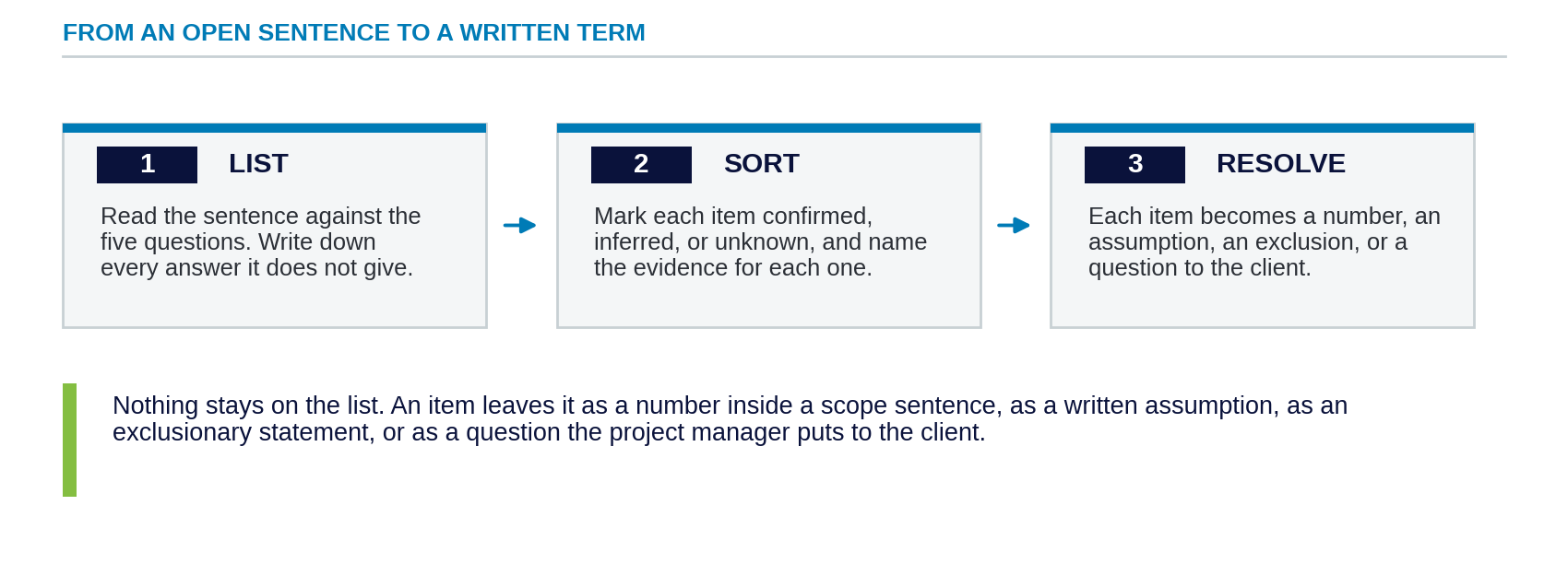
Remember: Every open item in a scope needs a clear endpoint. Resolve it as one of four things: a number in the scope sentence, a written assumption, an exclusionary statement, or a question the project manager asks the client before executing the agreement.
2.2.3 Writing assumptions
In a , an is a condition the scope depends on that the client has not . When an assumption is identified, the project manager separates what the team knows from what it is inferring, and documents the inference.
A written assumption holds three parts:
- The condition the scope depends on,
- The quantity that condition carries, and
- The result if the condition changes.
Consider a scope that depends on the length of the client review period. The client controls that period, but our schedule depends on it.
Recommended: Weston & Sampson assumes the client will return one consolidated set of comments on each submittal within 15 working days. A longer review period will extend the design schedule and may require additional compensation.
The condition is one consolidated set of comments, the quantity is 15 working days, and the result is a longer schedule and a possible . The quantity makes the assumption testable, and the stated result ties automatic consequences to any breach of the assumption.
Each assumption appears alongside the or risk it conditions. The assumptions from every discipline are then summarized in an assumptions section at the end of the scope.
Work it through. A draft assumption reads: Weston & Sampson assumes the client will provide existing record drawings. Name the two parts it is missing. Check your work: the sentence carries a condition and no quantity, so it does not say how many drawings or by what date, and it does not say what happens if the drawings never arrive.
Remember: An assumption names a condition, a quantity, and a result. These statements make implicit expectations explicit and provide a basis for all future conversations about assumed conditions that impact the project.
2.2.4 Writing exclusions
Three statements classify work that falls outside Weston & Sampson’s . Each identifies specific types of work the fee does not include. This section groups them as three statements a project manager verifies as part of the scope writing process.
2.2.4.1 Work Weston & Sampson will not perform
This statement identifies and isolates work inside the project that our firm has chosen not to perform, so that the client reads it and knows to procure that work elsewhere.
2.2.4.2 Work others perform
This statement identifies work the project requires that a different party performs, including the client or the owner, and it names that party. A statement that says the work is by others without naming anyone leaves the same gap it was written to close.
2.2.4.3 Work excluded from the scope
This statement identifies work that a reasonable client could expect to find in the scope and that the fee does not cover, which removes ambiguity from the work the scope identifies and eliminates about missed scope.
Consider the following passage which carries all three ideas about a permitting scope on a sample project.
Not recommended: This scope of work assumes that the following permits and approvals are required: DHEC Permit to Construct, USACE Jurisdictional Determination, and City MS4 Approval.
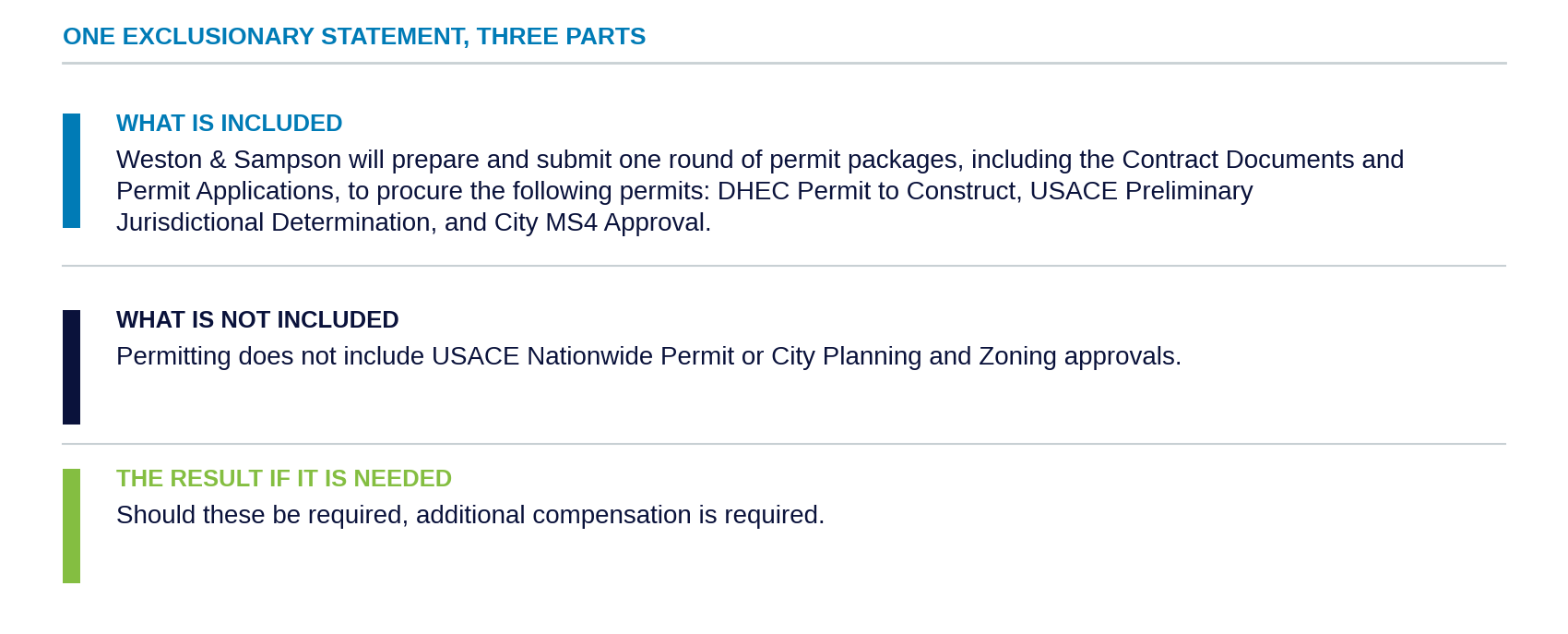
Recommended: Weston & Sampson will prepare and submit one round of permit packages, including the Contract Documents and Permit Applications, to procure the following permits: DHEC Permit to Construct, USACE Preliminary Jurisdictional Determination, and City MS4 Approval. Permitting does not include USACE Nationwide Permit or City Planning and Zoning approvals. Should these be required, additional compensation is required.
The recommended passage states what is included, states what is not included, and states the result if excluded work becomes necessary. The other passage states only the first, which leaves a client with no reason to believe any permit was left out.
Think of a task your team performed that the client believed was included in the fee. Which of the three statements would have settled the question before the work began?
Most of these disputes trace to the second statement. The work was always going to be performed by somebody, and the scope named no party, so the client read the silence one way and the project team read it the other.
Remember: Exclusionary statements identify specific pieces of the work that Weston & Sampson will not perform. These statements backstop any potential ambiguity that creeps into our definitions of work we will perform, and are a critical component of a clear, effective, defensible scope.
2.2.5 An example
Consider a stormwater drainage design for a municipal client, where a first draft of one scope paragraph reads as follows.
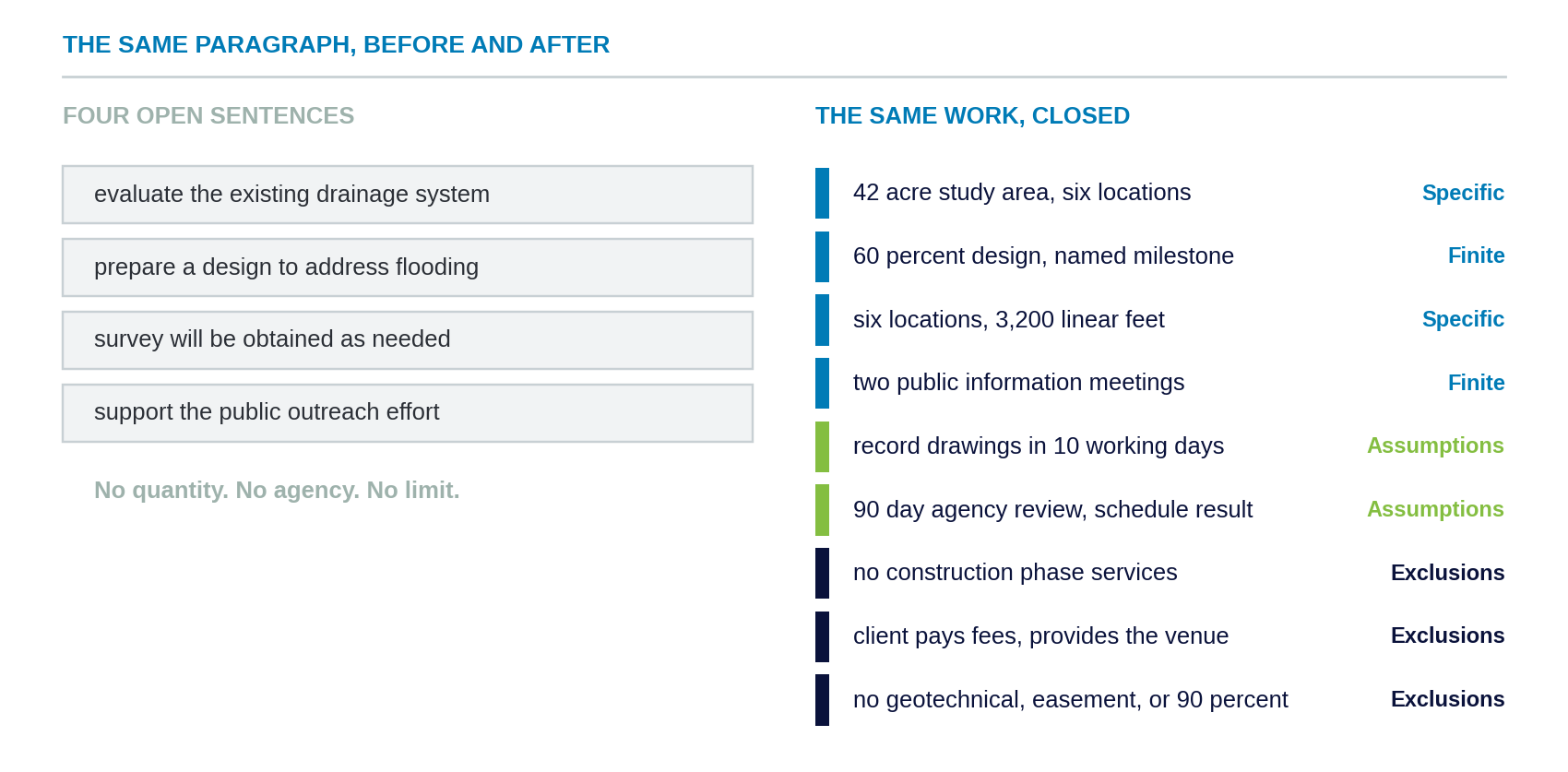
Not recommended: Weston & Sampson will evaluate the existing drainage system and prepare a design to address flooding in the study area. Survey will be obtained as needed. The design will be permitted through the applicable agencies. Weston & Sampson will support the public outreach effort.
Four sentences produce four open questions. The passage states no quantity for the survey, no agency by name, no count for the public outreach, and no limit on the evaluation.
The rewrite below adds two and three exclusionary statements.
Recommended: Weston & Sampson will evaluate the existing drainage system within the 42 acre study area and will prepare a 60 percent design to address flooding at the six locations identified in the . Weston & Sampson will obtain a topographic survey of the six locations and of 3,200 linear feet of connecting right of way. Weston & Sampson will prepare and submit one round of permit applications to the state environmental agency and to the regional water management district. One Weston & Sampson staff member will attend two public information meetings, for a total of two contact hours, and will prepare up to three pages of exhibits for each one.
Assumptions: Weston & Sampson assumes the client will provide record drawings for the existing system within 10 working days of the notice to proceed. Weston & Sampson assumes each permit agency will complete its review within 90 days of a complete application. A longer review will extend the schedule.
: Weston & Sampson will not perform construction phase services. The client will pay all permit application fees and will provide the meeting venue for each public information meeting. This scope excludes geotechnical investigation, easement acquisition, and design beyond the 60 percent milestone. Should any of these be required, additional compensation will be needed.
2.2.6 Summary
A scope passage that fails a review question is short of information. The project manager uses three steps to close the open gaps.
- List what the sentence does not say.
- Sort each item as , , or .
- Resolve each item as a number in the sentence, an , an , or a question to the client.
An assumption states the condition, the quantity, and the result if the condition changes. It sits alongside the it conditions, and again in an assumptions section that collects the conditions from every discipline. Three exclusionary statements then close the scope: the work our firm will not perform, the work others perform, and the work excluded from the scope.
The now states the work, its conditions, and its limits for the client. The people who perform that work need the same answer in a different form. Lesson 2.3 covers the .
Remember
- A scope sentence that leaves a question open does not remove the work. It moves the decision about that work from the negotiating table into the middle of the project. Section 2.2.1
- Every open item in a scope needs a clear endpoint. Resolve it as one of four things: a number in the scope sentence, a written assumption, an exclusionary statement, or a question the project manager asks the client before executing the agreement. Section 2.2.2
- An assumption names a condition, a quantity, and a result. These statements make implicit expectations explicit and provide a basis for all future conversations about assumed conditions that impact the project. Section 2.2.3
- Exclusionary statements identify specific pieces of the work that Weston & Sampson will not perform. These statements backstop any potential ambiguity that creeps into our definitions of work we will perform, and are a critical component of a clear, effective, defensible scope. Section 2.2.4