

PROJECT MANAGEMENT 101 AT WESTON & SAMPSON
MODULE 1 · WEEK 4
THE PROPOSAL KICKOFF MEETING
Approximate reading time: 6 minutes
Module 0 defined our firm’s overall economic model.
Week 1 covered the pursuit, prepositioning, and value discovery.
Week 2 covered the Go/No-Go decision.
Week 3 covered the pursuit roles and the opportunity record in Deltek Vantagepoint.
Week 4 now covers the meeting that turns a Go decision into a proposal.
This lesson covers four subjects:
What gets decided in the kickoff meeting.
The Proposal Kickoff Form.
The proposal schedule, the win themes, and the internal handoffs.
The reviews that major and federal proposals require.
The kickoff sets the proposal strategy and every internal deadline the pursuit team works with through completion.
MODULE 1 PURPOSE AND SCOPE
Module 1 covers the pursuit, the period before a project exists. Participants learn how Weston & Sampson identifies, evaluates, prices, and records an opportunity. They also learn how those decisions affect value for the client and for our firm. Three companies make up Weston & Sampson, and this course addresses the engineering company only.
WHERE THIS FITS
Module 0 · The Business of Weston & Sampson
Module 1 · Project Pursuit
Week 1 · The Pursuit, from Lead to Award
Week 2 · The Go/No-Go Decision
Week 3 · Pursuit Roles and the Opportunity Record
Week 4 · The Proposal Kickoff Meeting (you are here)
Module 2 · Scope
Module 3 · Schedule
Module 4 · Budgeting and Project Economics
Lesson objectives
This lesson closes Module 1. After completing this lesson, a project manager will be able to:
- Explain the purpose of the proposal kickoff meeting and name the items the Proposal Kickoff Form requires.
- Establish the network of internal handoffs that drive a pursuit toward issuance of a proposal.
- Define a win theme and explain how win themes link to the argument our firm makes for why this client should select Weston & Sampson.
- State when a proposal requires color team reviews, and when the federal review sequence applies.
1.4.1 The proposal kickoff meeting
The is the first formal meeting after a Go decision, where the pursuit team turns the opportunity into an organized proposal effort. The meeting aligns the , , , project manager (if known), and key contributors on the client’s requirements, the proposal strategy, the work to be completed, and the deadlines that will carry the pursuit through submission.
At the , the Marketing Lead and the Technical Lead define and assign the work of the proposal. This meeting establishes a uniform understanding of the requirements, the complete project team including subconsultants, the approach, the , the three , and the content required to assemble the final proposal.
The meeting establishes the proposal focus, the internal schedule, the responsibilities, the delivery method, and the fee format.
Remember: The kickoff meeting sets the proposal strategy and the internal deadlines.
1.4.2 Before the kickoff
Before the kickoff, someone reads the whole solicitation, completes the , logs the opportunity in , and identifies the . The Technical Lead determines the disciplines required to meet the requirements of the solicitation and sends the solicitation to those discipline and practice leaders. Marketing staff schedule the mandatory according to the flow below.
The proposal preparation process
The Technical Lead must commit to the schedule as Technical Champion before the Go/No-Go form reaches Marketing.
1.4.2.1 What Marketing needs from the pursuit team
Marketing needs four inputs from the pursuit team to develop the proposal accurately and on time:
- Adequate . Submit the Go/No-Go form in Deltek Vantagepoint at least two weeks before the proposal deadline.
- Schedule commitment. The Technical Lead confirms the proposal schedule and deadlines before the form reaches Marketing.
- Current materials. Keep resumes and project sheets updated between pursuits or identify at the which project references you want to use and which need to be updated.
- Forecast data. Record the estimated proposal
hours on the Go/No-Go form. For reference, Technical Lead time averaged
approximately 35 hours per proposal in 2024. Weston & Sampson
targets proposal costs of 3 to 5 percent of total project value.
Proposal costs include the marketing and technical team time at raw
cost. This percentage drops with higher value pursuits.
What Marketing needs from the pursuit team, and when
Every date above is a commitment the pursuit team makes to people producing other proposals the same week.
1.4.3 The Proposal Kickoff Form
The creates the agenda for the proposal kickoff meeting. This serves as a roadmap for the conversation and helps the pursuit team align on the approach it will take to prepare the proposal. The Proposal Kickoff Form covers these items:
- The proposal focus and the ,
- Roles defined for the , the , and any second technical reviewer,
- The complete team, the subconsultants, and the disadvantaged business enterprise goals if appropriate,
- The , and how our firm meets each,
- The relevant projects and the to write,
- Who completes the fee proposal, and whether accessible deliverables are required,
- The photography, graphics, and format needs, and
- The internal deadline for every handoff, agreed by the people who owe the work.
1.4.4 The win themes
Each proposal aims to answer the question:
Why should this client select Weston & Sampson?
The proposal aims to answer this question by integrating into the proposal. A win theme is a central proposal message that connects a client priority to a specific Weston & Sampson strength and explains the resulting client benefit.
Three win themes are recorded on the . Marketing, technical staff, and operations each propose a different theme, and the project manager prepares one strategy that uses all three, so that the client receives one message.
1.4.5 The proposal schedule and the handoffs
Marketing is responsible for the proposal schedule, which depends on three commitments from the pursuit team:
- Meet the agreed internal deadlines, and complete technical components 24 hours before production.
- Brief Marketing on , since the , the cover letter, and the approach depend on it.
- Schedule the at the , at approximately 60 percent completion for general direction and again at approximately 95 percent as the final review.
The confirms the team composition within 48 hours and introduces the to any subconsultants within 24 hours. The technical components are completed 24 hours before production, after which Marketing owns completion and quality.
Build the proposal schedule backward from the due date, around the holidays and vacations of the people you depend on. Package electronic submissions 24 hours before the deadline.
1.4.5.1 An example
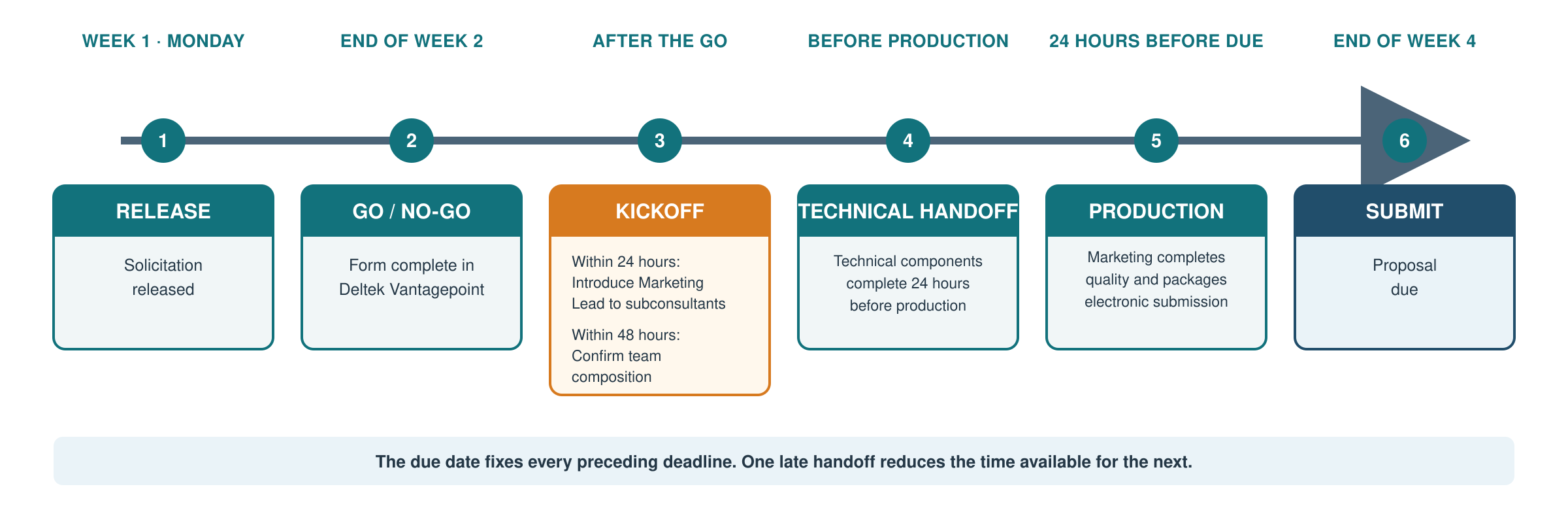
Take a solicitation released on a Monday, with responses due in four weeks.
Marketing needs the in two weeks before the response is due, so the form is complete by the end of the second week.
The kickoff follows the . The Technical Lead confirms the team composition within 48 hours of the kickoff and introduces the Marketing Lead to every subconsultant within 24 hours. The technical components are complete 24 hours before production, after which Marketing owns completion and quality. The team packages the electronic submission 24 hours before the deadline.
The due date fixes every date in that sequence. A date that moves because the work was not ready moves the deadline of somebody else.
1.4.6 Reviews on major and federal proposals
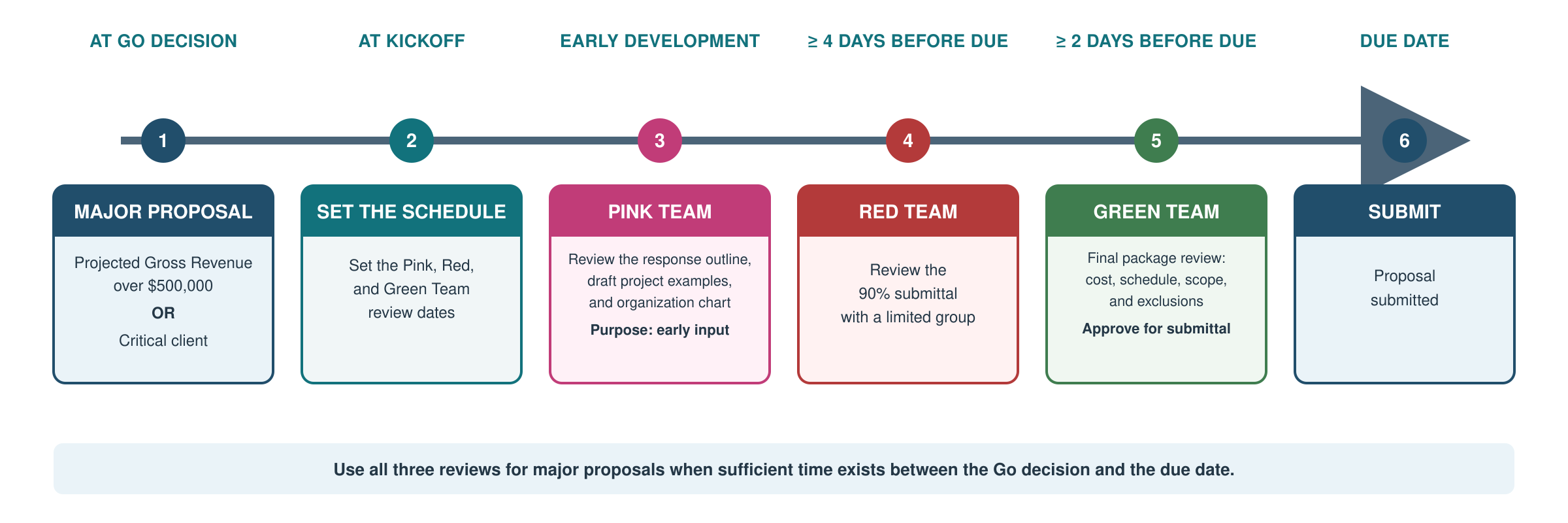
This standard process applies across all proposals, with some changes to it for proposals considered to be . A major proposal has more than $500,000 of or targets a critical client.
For major proposals and where enough time exists between release date/ and due date, our firm uses a color-designated review system: Pink Team, Red Team, and . The schedule for these reviews is set at the kick-off meeting.
- is a review of an outline of the response with a draft of projects and organizational chart. It allows people to provide input at the earliest of the proposal process.
- evaluates the submittal at approximately 90 percent completion with a limited group of people. It is held not less than 4 days before submittal.
- Green Team review is the final review of the package, focused on its cost portion. It occurs not less than 2 days before submittal and confirms that costs, schedule, scope, , and exclusions agree before final approval for submittal.
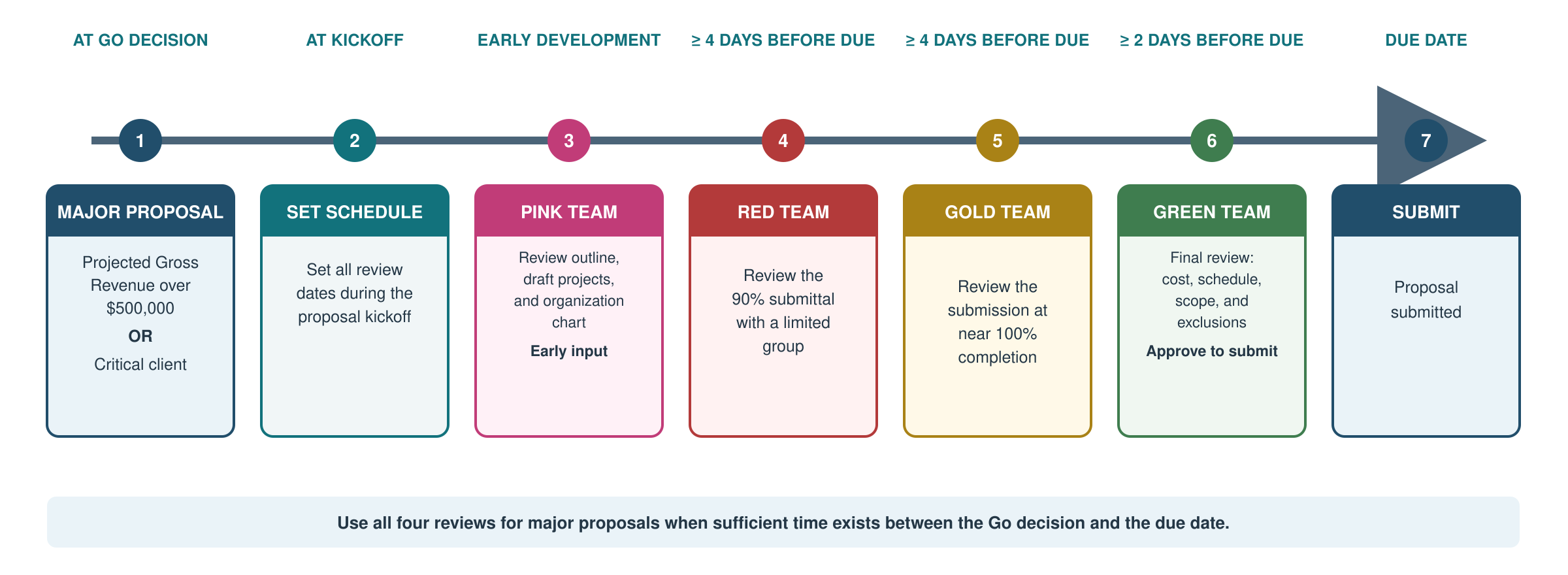
Federal proposals require four reviews, the Pink, Red, Gold, and Green Team reviews.
follows the Red Team review and precedes the Green Team review. It occurs not less than 4 days before submittal and reviews the submission at near 100% completion.
1.4.7 Summary
The turns a into a coordinated plan for developing and submitting the proposal. The pursuit team confirms the client’s evaluation criteria, , roles, technical inputs, production schedule, and review deadlines, with each milestone working backward from the submission date.
add Pink, Red, and , and federal proposals add a , to test the response from its initial outline through final approval.
Clear ownership and timely handoffs allow Marketing to complete production and without compressing the time available before submission.
Remember
- The kickoff meeting sets the proposal strategy and the internal deadlines. Section 1.4.1