

PROJECT MANAGEMENT 101 AT WESTON & SAMPSON
MODULE 2 · WEEK 3
THE WORK BREAKDOWN STRUCTURE
Approximate reading time: 10 minutes
The scope of services tells the client what our firm will deliver. The Work Breakdown Structure organizes that same work for the people who perform it.
This lesson covers five subjects:
The question the scope and the structure answer together,
The three levels of a Work Breakdown Structure,
The three rules that make a structure complete,
Where an assumption sits in the structure, and
Where excluded work sits in the structure.
MODULE 2 PURPOSE AND SCOPE
Module 2 covers scope development, the step that turns a winning approach into work our firm can deliver and defend. Participants learn how Weston & Sampson writes a scope of services, tests it, states its assumptions and exclusions, and organizes the same work into a Work Breakdown Structure.
WHERE THIS FITS
Module 0 · The Business of Weston & Sampson
Module 1 · Project Pursuit
Module 2 · Scope Development
Week 1 · Writing the Scope of Services
Week 2 · Assumptions and Exclusions
Week 3 · The Work Breakdown Structure (you are here)
Week 4 · Building the WBS from the Proposal
Module 3 · Schedule
Module 4 · Budgeting and Project Economics
Lesson objectives
After completing this lesson, a project manager will be able to:
- Explain how the scope of services and the Work Breakdown Structure together answer the first key question of the project management plan.
- Define phase, task, and subtask, and identify where each level appears in the Project Description Form, the schedule, and the Project Cost Spreadsheet.
- Apply three rules to a Work Breakdown Structure: it holds all of the scope and no work outside it, each element appears once, and each element has one owner.
- Attach each assumption to the task it conditions, and confirm that excluded work does not appear in the structure.
2.3.1 What is the work?
A answers six key questions. The first is the one this module has been working toward: What is the work?
Our firm answers that question twice. The answers it for the client, in sentences a client can read, visualize, and price. The (WBS) answers it for the project team, in elements a project manager can assign, schedule, and budget.
The remaining five questions in the project management plan depend on answering the first question accurately and completely, because team, cost, schedule, client requirements, and technical quality all flow out of the defined work the WBS communicates.
A project manager who starts with the second question staffs a project nobody has defined.
A WBS organizes the scope of work into , , and . Every element defined in the scope carries through into the schedule and into the budget. The structure is built once and used and reused in multiple other parts of the plan.
Remember: The scope of services and the Work Breakdown Structure answer one question for two audiences. The client reads the first. The project team works from the second.
2.3.2 Phase, task, and subtask
Our firm uses three levels to define the . Each level serves a specific purpose.
- . A phase is a major stage of the project that ends at a milestone or a major deliverable. Preliminary design, 60 percent design, and bid support are all phases, and project management runs through every one of them and is itself a phase.
- . A task is a defined part of a phase that produces a deliverable or a result. Topographic survey, hydraulic modeling, and the engineer’s opinion of probable cost are all examples of tasks. Deliverables attach to tasks and not to phases.
- . A subtask is the smallest unit of work the project manager assigns. One discipline performs it, and it has a defined output or end.
A subtask stops at the level where one discipline performs it, the team can estimate the hours it takes, and it has a defined end that somebody can observe. Those same three conditions decide how far any element in the structure is broken down.
Each level surfaces in a different document, as shown below, which is why the three are worth naming precisely.
| Level | What it is | Where it appears |
|---|---|---|
| Phase | A major stage that ends at a milestone or a major deliverable | The , the schedule, and the project folder |
| Task | A defined part of a phase that produces a deliverable or a result | The Project Description Form, the schedule, and the |
| Subtask | The smallest unit the project manager assigns to one discipline | The schedule and the Project Cost Spreadsheet |
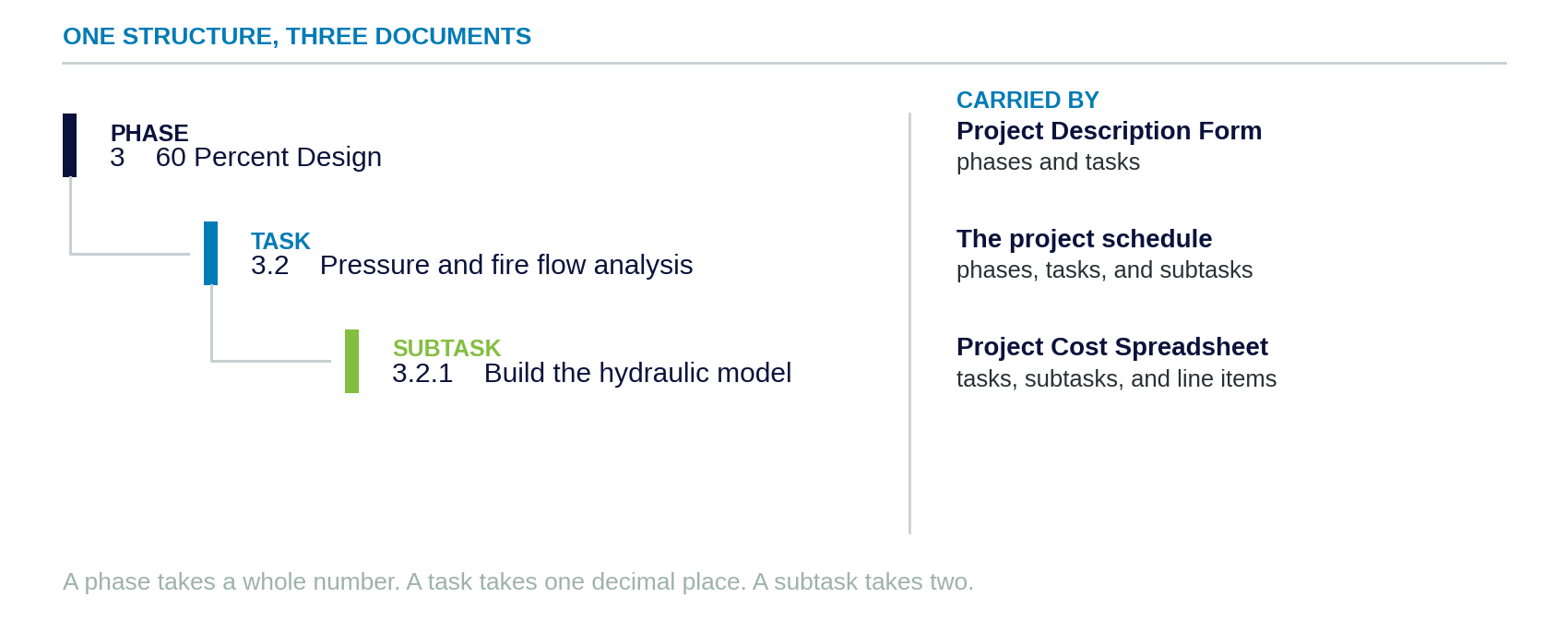
The project manager uses the Project Description Form to open the project number. The naming convention initialized in the Project Description Form ties the WBS to the accounting structure for the project. The conventions used for Phases and Tasks specifically become the accounting structure the project is charged against. This structure gets built once and sets how the project is billed, tracked, and reported.
Remember: Phase, task, and subtask are the same three levels the Project Description Form, the schedule, and the Project Cost Spreadsheet use to bill, track, assign, and report project progress. Adherence to this structure ensures that no translation between the person doing the work, the project manager leading the project, and the team invoicing the work is later required.
2.3.3 Three rules for a complete structure
Three rules decide whether a is finished. A structure that meets all three needs no further review before it becomes the reference the schedule and the budget are built from.
2.3.3.1 All of the scope, and nothing else
Every sentence of the has a WBS element tied to it, and no element performs work the scope does not contain. Our firm applies the same two part test to a project budget, and since the budget follows the structure, the test starts at the WBS.
Work that appears in the structure and not in the scope is work our firm plans to perform without payment, and work that appears in the scope and not in the structure is work our firm has promised to deliver but that has not been assigned.
2.3.3.2 Each element of work appears once
Each discipline prepares its own scope, and the project manager incorporates those scopes into one document. The risk is that two disciplines may inadvertently describe the same WBS elements, since multiple disciplines may rely upon outputs from the same work. A structure that carries duplicate WBS elements under multiple disciplines can be staffed twice and charged twice. A duplicate reaches the schedule too, showing a duration that nobody actually performs. The project manager should ensure that elements of work appear only once and are grouped under the discipline that performs the work.
2.3.3.3 Each element has one owner
One discipline owns each and each . Responsibility for tasks is a required part of the and it is recorded at the level where work is assigned. Where two disciplines contribute, the structure splits the element rather than naming two .
This is the rule that most often fails quietly, because two disciplines can each believe a shared task is the other one’s responsibility.
A Work Breakdown Structure names work, and it carries no dates, no staff hours, and no cost. Module 3 sequences these elements into a schedule, and Module 4 assigns staff and cost to them.
Work it through. A draft structure lists a task called project coordination under every one of five phases.
Name the rule it breaks.
Check your work: coordination has no defined end and no single discipline, so it is not a task.
Project management is the phase that carries it.
Remember: A complete structure holds all of the scope, holds each element once, and gives each element one owner.
2.3.4 Assumptions in the structure
Lesson 2.2 placed each alongside the it conditions in the . The same rule governs the structure. The assumption travels with the element, so the person assigned to the work receives the assumption information right next to the they are assigned to work on.
Consider a subtask that depends on record drawings the client has agreed to supply, where the assumption naming the count and the date sits on that subtask. An engineer who opens the assignment learns what the fee covers and what to raise if the drawings arrive late.
Section 2.3.6 works through a complete structure where an assumption is attached to one of the tasks, to show what this looks like in a finished document.
Work that others perform is the exception that needs care, because it produces no Weston & Sampson element and yet the project still depends on it. The element that depends on it carries an assumption naming the other party and the date the work is needed.
Remember: An assumption rides on the element it conditions.
2.3.5 Exclusions in the structure
work in the other direction. Work our firm will not perform and work excluded from the scope produce no element at any level.
The same example in Section 2.3.6 shows an exclusion that removes an entire from the structure, rather than leaving a gap inside it.
Think of a project where a team member performed work nobody had planned. Trace it back one step. Was the work missing from the structure, or was it excluded from the scope and built into the structure anyway?
Both failures produce the same week. The difference appears at invoicing. Work missing from the structure is usually inside the fee and unstaffed. Excluded work built into the structure is outside the fee and staffed, and it needs an amendment before anyone starts it.
Remember: Excluded work produces no element at all.
2.3.6 An example
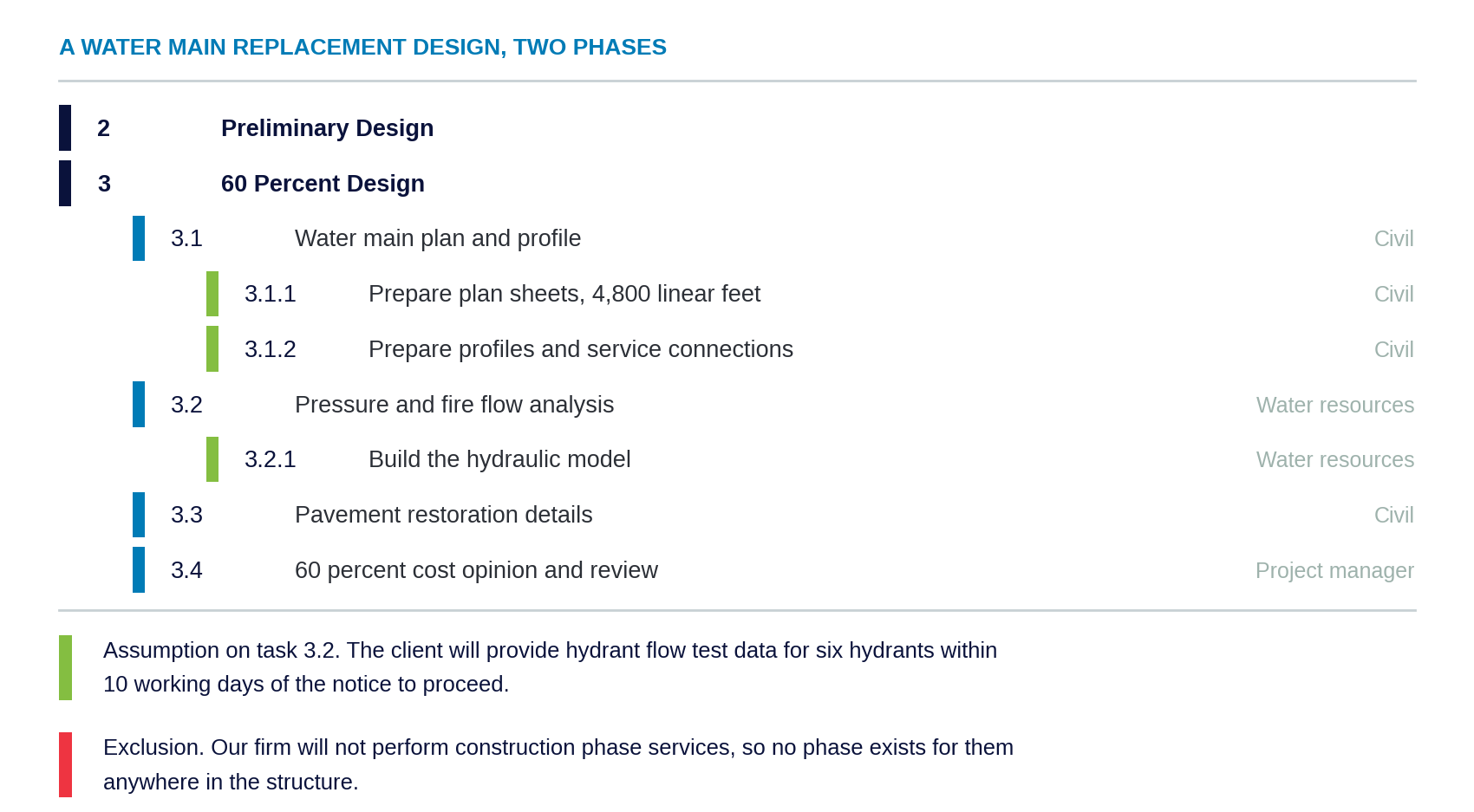
Consider a water main replacement design for a municipal client, shown below as two , with the under the second phase and the under one of them.
2 Preliminary Design
3 60 Percent Design
3.1 Water main plan and profile Civil
3.1.1 Prepare plan sheets for 4,800 linear feet Civil
3.1.2 Prepare profile sheets and service connections Civil
3.2 Pressure and fire flow analysis Water resources
3.2.1 Build the hydraulic model of the replacement main Water resources
3.3 Pavement restoration details Civil
3.4 60 percent cost opinion and review Project manager
Task 3.2 carries an written in the Lesson 2.2 form: Weston & Sampson assumes the client will provide hydrant flow test data for the six hydrants in the study area within 10 working days of the notice to proceed. Collecting that data would be new work, and the assumption is what makes that potential scope visible.
One removed an element before the structure was numbered. The scope states that our firm will not perform construction phase services, so no phase exists for them, and a reader who expects to find construction administration here finds the answer in the scope instead.
Task 3.4 is worth one note. A cost opinion and a milestone review are both work, both take hours, and both belong to the project manager rather than to a design discipline. These are two discrete tasks and should be separated and treated as such.
This structure satisfies all three rules: it holds every element of the scope, no element repeats, and every task carries one .
2.3.7 Summary
The first question a asks is: What is the work?
The answers for the client and the answers for the team. Both answers use , , and . The , the schedule, and the all carry those three levels.
A complete structure holds all of the scope and no work outside it, holds each element of work once, and gives each element one . It stops at the level where one discipline can be assigned, the hours estimated, and the finish observed. Each sits alongside the element it conditions.
Every structure in this lesson was built from a scope that was already written. On a real project the two documents are built together, from an awarded proposal, and they drift apart as both are edited.
Remember
- The scope of services and the Work Breakdown Structure answer one question for two audiences. The client reads the first. The project team works from the second. Section 2.3.1
- Phase, task, and subtask are the same three levels the Project Description Form, the schedule, and the Project Cost Spreadsheet use to bill, track, assign, and report project progress. Adherence to this structure ensures that no translation between the person doing the work, the project manager leading the project, and the team invoicing the work is later required. Section 2.3.2
- A complete structure holds all of the scope, holds each element once, and gives each element one owner. Section 2.3.3
- An assumption rides on the element it conditions. Section 2.3.4
- Excluded work produces no element at all. Section 2.3.5