

PROJECT MANAGEMENT 101 AT WESTON & SAMPSON
MODULE 2 · WEEK 1
WRITING THE SCOPE OF SERVICES
Approximate reading time: 10 minutes
A proposal approach wins the work. The scope of services states the work our firm commits to deliver under the agreement.
This lesson covers four subjects:
The difference between an approach and a scope of services,
The steps our firm uses to define the scope,
The mandatory scope writing standards, and
The SAFER filter, a five question review of scope language.
MODULE 2 PURPOSE AND SCOPE
Module 2 covers scope development, the step that turns a winning approach into work our firm can deliver and defend. Participants learn how Weston & Sampson writes a scope of services, tests it, states its assumptions and exclusions, and organizes the same work into a Work Breakdown Structure.
WHERE THIS FITS
Module 0 · The Business of Weston & Sampson
Module 1 · Project Pursuit
Module 2 · Scope Development
Week 1 · Writing the Scope of Services (you are here)
Week 2 · Assumptions and Exclusions
Week 3 · The Work Breakdown Structure
Week 4 · Building the WBS from the Proposal
Module 3 · Schedule
Module 4 · Budgeting and Project Economics
Lesson objectives
After completing this lesson, a project manager will be able to:
- Distinguish a proposal approach from a scope of services, and state the purpose and the reader of each.
- Define a scope of services through the six preparation steps, and state a quantity for every task that will receive time.
- Apply the mandatory scope writing standards: the company name written in full, active voice, and the separate meanings of will, shall, and should.
- Test a scope passage against the five SAFER questions and name the question each defect fails.
2.1.1 Where the scope of services sits
An agreement serves six purposes, and the first is to define the scope and the project, which is why this module comes before schedule and budget.
The is also one of the three minimum parts of the , alongside the schedule with project milestones and the budget.
Our firm develops scope, fee, and schedule during the pursuit, before the project exists, since all three plan it at the moment it begins.
Lesson 1.4 covered the , which confirms that costs, schedule, scope, , and agree before a leaves our firm. That review tests the documents against each other, and this lesson covers the scope itself.
Remember: The first purpose of an agreement is to define the scope and the project. Everything else in the agreement, including compensation, describes work the scope has already defined.
2.1.2 Approach and scope
Often in Qualifications based solicitations or other formal solicitation types, Weston & Sampson is asked to describe how it would a project in general terms, before committing to a detailed articulation of the exact for the work. An approach is the proposal content that explains how our firm will solve the client’s problem. The prepares it along with the project team, and, when taken together with the fee and the schedule, it answers one question for the selection committee: why this firm.
Once selected, the Approach gives way to a formal Scope of Services that we write to define the exact work we will deliver as part of the project. A scope of services is the statement of the work, the deliverables, the quantities, and the limits our firm commits to under the agreement, and the project manager coordinates its preparation. It answers what the client is buying.
Both documents describe the same project for different readers. Approach and Scope of Services jointly become the legal boundary for our work on the project and taken together, define the client’s technical expectations for our work.
| Approach | Scope of services | |
|---|---|---|
| Purpose | Win the selection | Define the commitment |
| Reader | The selection committee | The client, the project team, and the |
| Author | The Technical Lead | The project manager, with each discipline |
| Language | Persuasive | Specific and measurable |
| Cost of a vague sentence | A weaker submission | Work our firm performs without payment |
Remember: An approach persuades a committee to select our firm. A scope of services defines what our firm has agreed to perform.
2.1.3 Defining the scope
The team that will perform the work writes the scope. Scope requirements develop through an iterative process with the people who will be held to them, so engagement of internal stakeholders is critical when developing the language.
The Weston & Sampson scope development process follows three simple steps:
- A scope of work shall be prepared for each discipline, by each discipline that will participate in the work,
- The project manager incorporates the separate scopes into one document, and
- The team reviews the final product before it is issued.
Before drafting, the project manager shall prepare the project information for the disciplines drafting the scope to optimally position the team toward the project’s goals, which are typically defined in the . To do so, the Project Manager completes six preparation steps:
- Define the objectives, the deliverables, and the client expectations for quality and timeline,
- Identify and communicate the expertise the project requires,
- Identify constraints, areas of concern, and unknowns,
- Collect the client provided documents and any similar past scopes,
- Discuss the project fully with the client and ask questions, and
- Discuss similar projects with other project managers to identify internal best practices.
Two of the six steps direct the project manager to ask questions. Many solicitations run a time sensitive question and answer process. Review the scope early enough to use it. Refer to each solicitation for communication requirements and prohibitions.
The transition from Approach to requires taking persuasive language written in the Approach and converting it to more concrete and specific language. Specifically, the Scope of Services identifies every aspect of the work, including key tasks, deliverables, client meetings, stakeholder coordination, permitting, bidding, and construction.
Each aspect of a Scope of Services is a description of the work our firm will perform. The language our firm uses in the Scope of Services creates a legal boundary for the work, so specificity and clarity are paramount. Each item in the Scope of Services should include specific numbers, names, periods of time, and staffing.
One test governs the language we use in the Scope of Services: if time will be allocated to a task, the task shall be quantifiable.
Take the following example to illustrate the differences between inappropriate and appropriate Scope language. Two sentences about the same meetings create two very different boundaries for our work.
Option 1: Working sessions will be held with the Owner to clarify details of the project.
Option 2: The project staff will meet with the client for two working sessions, coordinated with review of the basis of design. This scope assumes each meeting is three hours, including driving time.
Option 1 describes an unlimited number of meetings for an unlimited number of staff members for an undetermined amount of time. Option 2 carries a count and a duration, and the former carries neither. The latter is the only version that belongs in the Scope of Services. It is clear, specific, quantified, and defensible.
2.1.3.1 An example
Take a scope sentence that reads:
Attend progress meetings as needed.
How many possible ways could this be interpreted?
Based on experience, the project manager plans one meeting a month across a 12 month design. On the last project, the client’s consultant met every two weeks. At the outset, “as needed” has two different working definitions for the two parties.
Both parties signed the same agreement, and neither party wrote down a number.
26 meetings expected, 12 meetings planned, 14 meetings without budget
14 meetings × 2 staff × 3 hours = 84 hours
84 hours × $35 / hour rate = $2,940 of additional cost to the project.
Think back to Module 0 and Module 1. If this is a lump sum/fixed fee project with $204,000 of , these additional meetings reduce the for this project from our projected 3.30 to 3.15, potentially because of a single line in the Scope of Services.
Projected ELM = $204,000 Net Labor Revenue / $61,818 Direct Labor = 3.30
Revised ELM = $204,000 Net Labor Revenue / $64,758 Direct Labor* = 3.15
*Approximate additional staff cost at a $35 / hour direct labor cost.
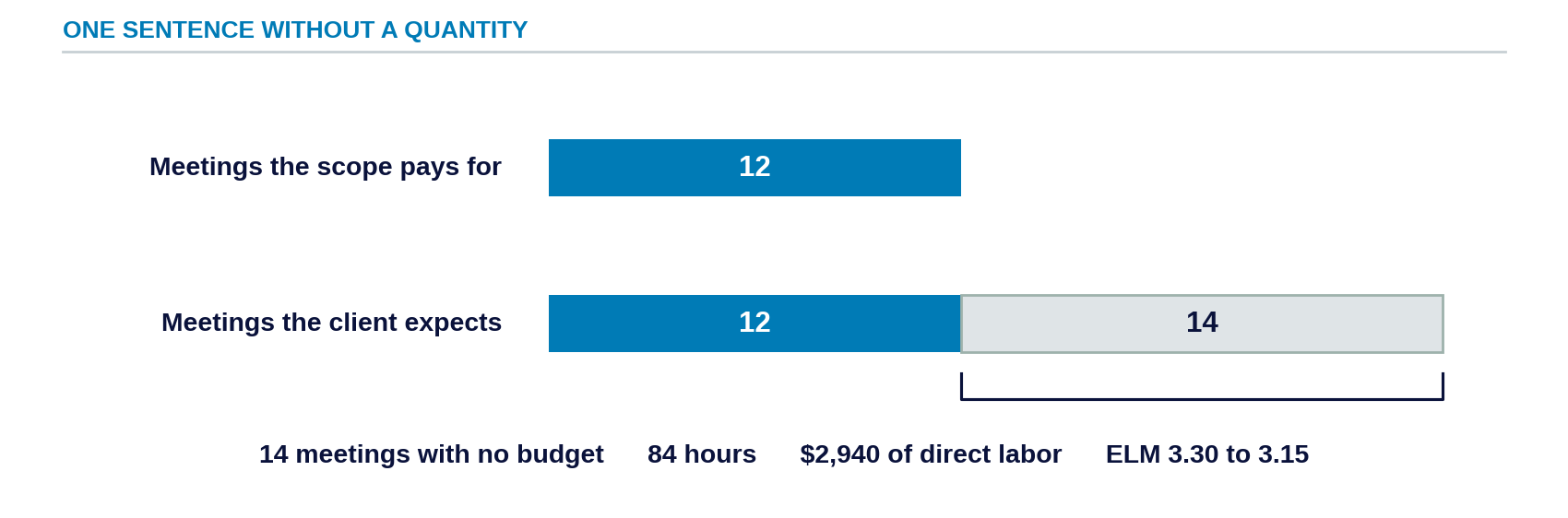
One rewrite closes any potential gap, as shown below.
Recommended: Weston & Sampson will attend 12 monthly progress meetings, each lasting three hours, with two staff members present.
Three elements changed.
- The sentence names the party,
- The sentence states how many meetings and how long each one runs,
- The sentence defines the staff whose time the fee covers.
These three rules help Weston & Sampson protect the time of our people and our financial performance, while providing clarity of expectations to a client about exactly what we agree to do before they hire our firm.
Remember: A task that will receive time receives a number. A count, a duration, and a named participant turn an intention into a commitment both parties can measure.
2.1.4 The mandatory writing standards
Four standards govern every sentence in a . The following section defines the four rules and provides examples of each in practice.
2.1.4.1 The company name
The company name is written as Weston & Sampson, in full, in every sentence of a scope of services where it appears, and it shall not be shortened to an acronym or an ampersand form.
2.1.4.2 Active voice
Every scope sentence is written in active voice.
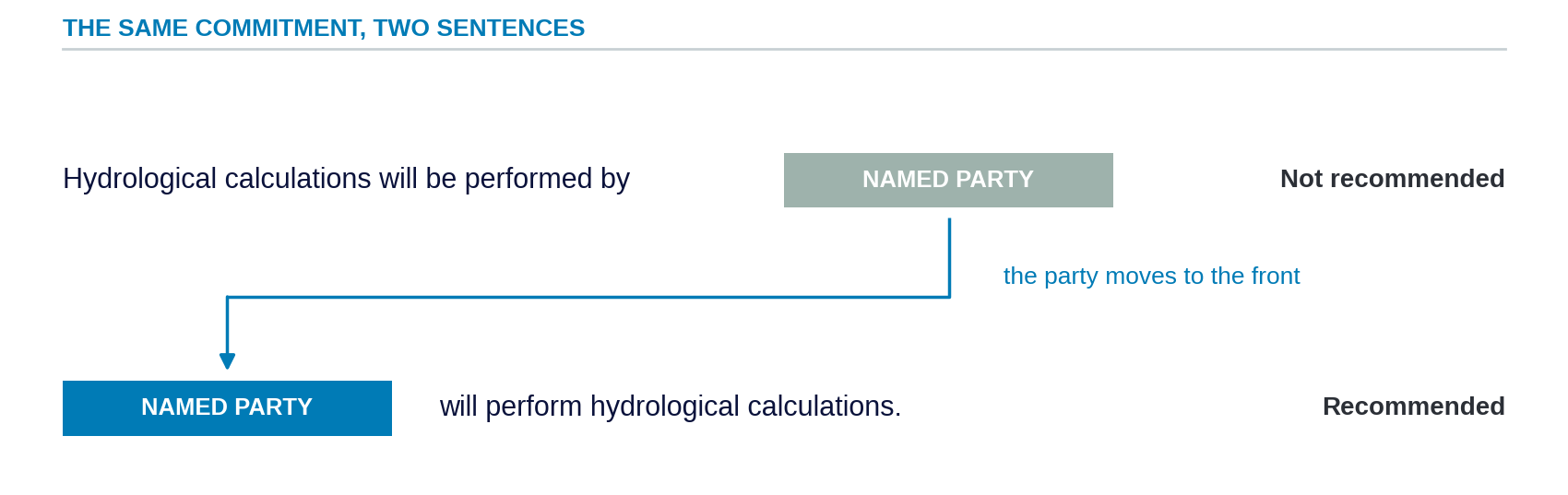
Not recommended: Hydrological calculations will be performed by Weston & Sampson.
Recommended: Weston & Sampson will perform hydrological calculations.
Both sentences describe the same work, but the active one names the performing party in its first three words while the passive delays that party to its last three.
Where a scope sentence has a subject that is not a named party, it should be rewritten to make it active voice, subject first.
2.1.4.3 Will, shall, and should
Three words carry three separate meanings in a scope of services. Each commits our firm to something different.
| Word | Meaning | A scope sentence that uses it |
|---|---|---|
| Will | A declaration of purpose or a statement of fact | Weston & Sampson will provide the deliverables listed in this scope. |
| Shall | A requirement | The design shall meet the requirements of the permitting authority. |
| Should | A best practice or a design criterion | The design should use corrosion resistant fasteners in the wet well. |
Do not use must in a scope of services. Use will for commitments Weston & Sampson makes and shall for requirements placed on the design.
That instruction governs scope sentences only and shall not be universally applied to every document our firm writes. Project Managers use must only when a statement expresses logical necessity.
2.1.4.4 Common language and open ended words
Scope language is written for a layperson, so technical terms are explained and acronyms avoided.
Avoid certain words and phrases in a scope of services because they leave the amount of work open to interpretation:
- all,
- but not limited to,
- as directed,
- is common practice in the industry, and
- subject to approval.
Work it through.
A draft sentence reads: Weston & Sampson shall attend all project meetings as directed by the Owner.
Name the three standards it breaks.
Check your work: shall states a requirement, and this sentence states what our firm will do, so will is correct. The sentence also uses all and as directed.
Remember: The writing standards name the party that performs the work, and they keep the limit of that work inside the document.
2.1.5 The SAFER filter
SAFER is a review filter that applies the Weston & Sampson writing requirements to scope statements to ensure clarity, accuracy, and defensibility. It is used to test language and determine if and where language requires refinement before being finalized.
The project manager applies it after a draft exists and before the client reads it.
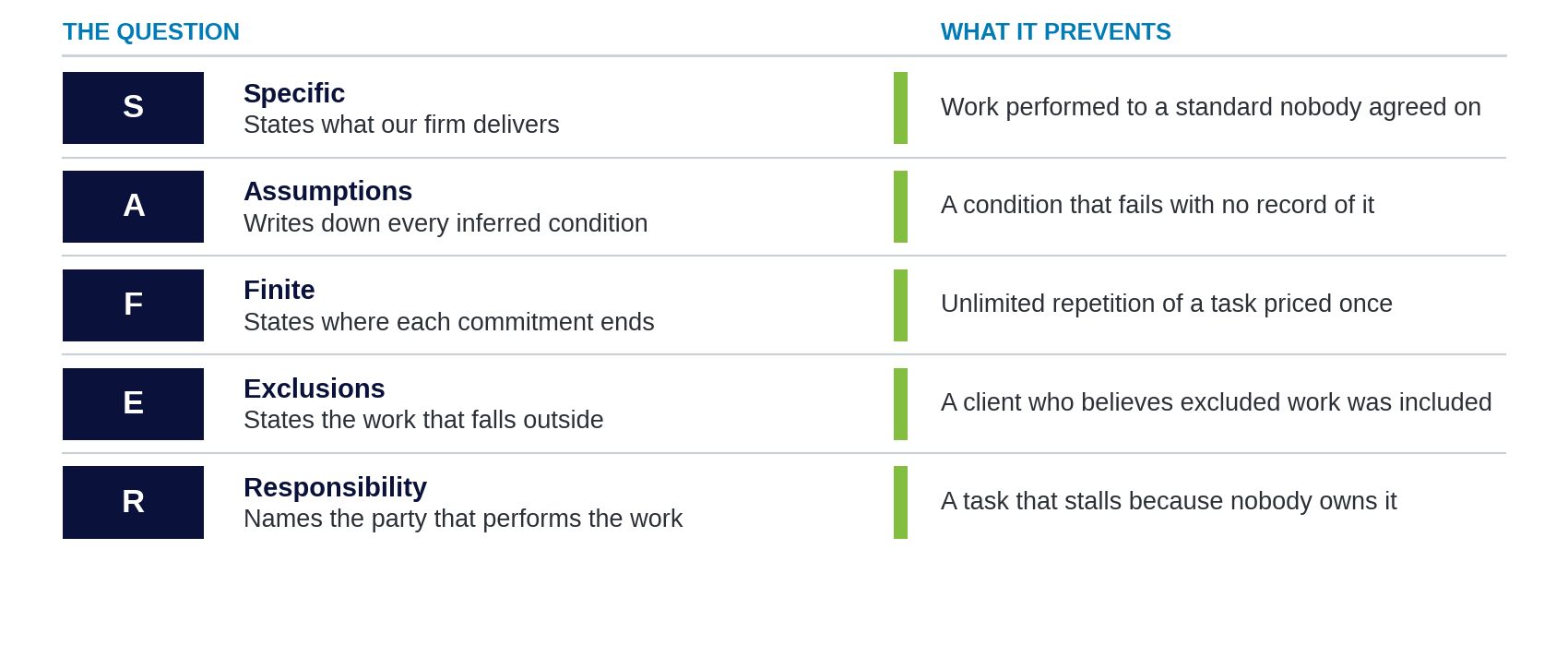
SAFER stands for:
Specific. A passage that describes activity rather than an outcome fails this question.
. Every scope depends on conditions the team has not , so the project manager separates what the team knows from what it is inferring and states each item as an assumption.
Finite. A count, a duration, or a stated limit is what ends a commitment.
. Three statements close a scope: the work our firm will not perform, the work others perform including the client or owner, and the work excluded entirely.
Responsibility. The active voice standard answers this question in most sentences, and where a discipline prepares its own scope, the named party is that discipline.
| Letter | The question the reviewer asks | What it prevents |
|---|---|---|
| S, Specific | Does the sentence state what our firm delivers, with quantities, names, and periods of time? | Work performed to a standard nobody agreed on |
| A, Assumptions | Is each condition the team inferred written down as an assumption? | A condition that fails with no record that anyone expected it to hold |
| F, Finite | Does each commitment state where it ends? | Unlimited repetition of a task priced once |
| E, Exclusions | Does the passage state the work that falls outside it? | A client who reasonably believes excluded work was included |
| R, Responsibility | Does each sentence name the party that performs the work? | A task that stalls because nobody owns the next action |
Think of a scope you wrote or inherited that produced a disagreement with the client about what was included. Which sentence caused it?
The sentence almost always lacked one of four things: a quantity, a stated limit, a protected exclusion, or a named party. The SAFER questions test for all four before the client reads the passage.
Remember: A scope passage can meet every writing standard and still fail. The standards govern how a sentence is written. The five questions test whether the sentence closed the commitment.
2.1.6 Summary
An helps win the selection. The defines the work Weston & Sampson agrees to perform and fulfills the agreement’s first purpose.
Each discipline drafts its portion of the scope, the project manager combines those sections into one document, and the team reviews the final version.
Every task that receives time needs a quantity. Every scope sentence uses the full company name, active voice, and the correct meaning of will, shall, or should.
The five SAFER questions test the finished passage. If a passage fails Specific or Finite, it needs a missing number. If it fails or , it needs missing sentences. Lesson 2.2 explains how project managers find that information and write the sentences that close those gaps.
Remember
- The first purpose of an agreement is to define the scope and the project. Everything else in the agreement, including compensation, describes work the scope has already defined. Section 2.1.1
- An approach persuades a committee to select our firm. A scope of services defines what our firm has agreed to perform. Section 2.1.2
- A task that will receive time receives a number. A count, a duration, and a named participant turn an intention into a commitment both parties can measure. Section 2.1.3
- The writing standards name the party that performs the work, and they keep the limit of that work inside the document. Section 2.1.4
- A scope passage can meet every writing standard and still fail. The standards govern how a sentence is written. The five questions test whether the sentence closed the commitment. Section 2.1.5