

PROJECT MANAGEMENT 101 AT WESTON & SAMPSON
MODULE 1 · WEEK 3
PURSUIT ROLES AND THE OPPORTUNITY RECORD
Approximate reading time: 10 minutes
A Go decision starts the proposal development process, which involves multiple parties and simultaneous activities, resulting in a submitted proposal.
This lesson covers four subjects:
The key Weston & Sampson pursuit roles,
The procedure for opening and updating an opportunity in Deltek Vantagepoint,
Weighted labor revenue, the forecast the opportunity record produces, and
The entries to update after a client conversation.
MODULE 1 PURPOSE AND SCOPE
Module 1 covers the pursuit, the period before a project exists. Participants learn how Weston & Sampson identifies, evaluates, prices, and records an opportunity. They also learn how those decisions affect value for the client and for our firm. Three companies make up Weston & Sampson, and this course addresses the engineering company only.
WHERE THIS FITS
Module 0 · The Business of Weston & Sampson
Module 1 · Project Pursuit
Week 1 · The Pursuit, from Lead to Award
Week 2 · The Go/No-Go Decision
Week 3 · Pursuit Roles and the Opportunity Record (you are here)
Week 4 · The Proposal Kickoff Meeting
Module 2 · Scope
Module 3 · Schedule
Module 4 · Budgeting and Project Economics
Lesson objectives
After completing this lesson, a project manager will be able to:
- Distinguish Marketing Lead responsibilities from Technical Lead responsibilities, and name the supporting marketing and technical roles.
- Understand how opportunities are opened in Deltek Vantagepoint, including identification of Stage, Projected Gross Revenue, Other Direct Costs (ODC), win probability, and proposal number.
- Calculate the weighted labor revenue of an opportunity, and explain how our firm plans staffing and hiring against it.
- Update the opportunity record after a client conversation, and keep it current every month and at every stage change.
1.3.1 What a Go decision starts
After a , the schedules the proposal . One of the first steps in the pursuit is initial team formation. Below the scored questions, the records the eight pursuit information fields covered in Week 2, and those fields name the people and roles that support the proposal going forward.
Remember: A Go decision starts the work of the pursuit and identifies roles that will support and organize that work.
1.3.2 The pursuit roles
Proposal preparation is a team sport at Weston & Sampson. The section below outlines the parties involved in proposal preparation and outlines their responsibilities to the process.
1.3.2.1 The Marketing Lead and the Technical Lead
The (ML) leads preparation of the proposal package, which includes identifying qualifications, references, and example projects to showcase in the proposal. The ML also ensures that the submission, when packaged for submission, meets the solicitation requirements.
The (TL) leads preparation of technical content. The TL can be a project manager, technical leader, team leader, practice leader, or experienced in the project type and familiar with our capabilities. The TL identifies the optimal project team, the approach, the fee, and the schedule.
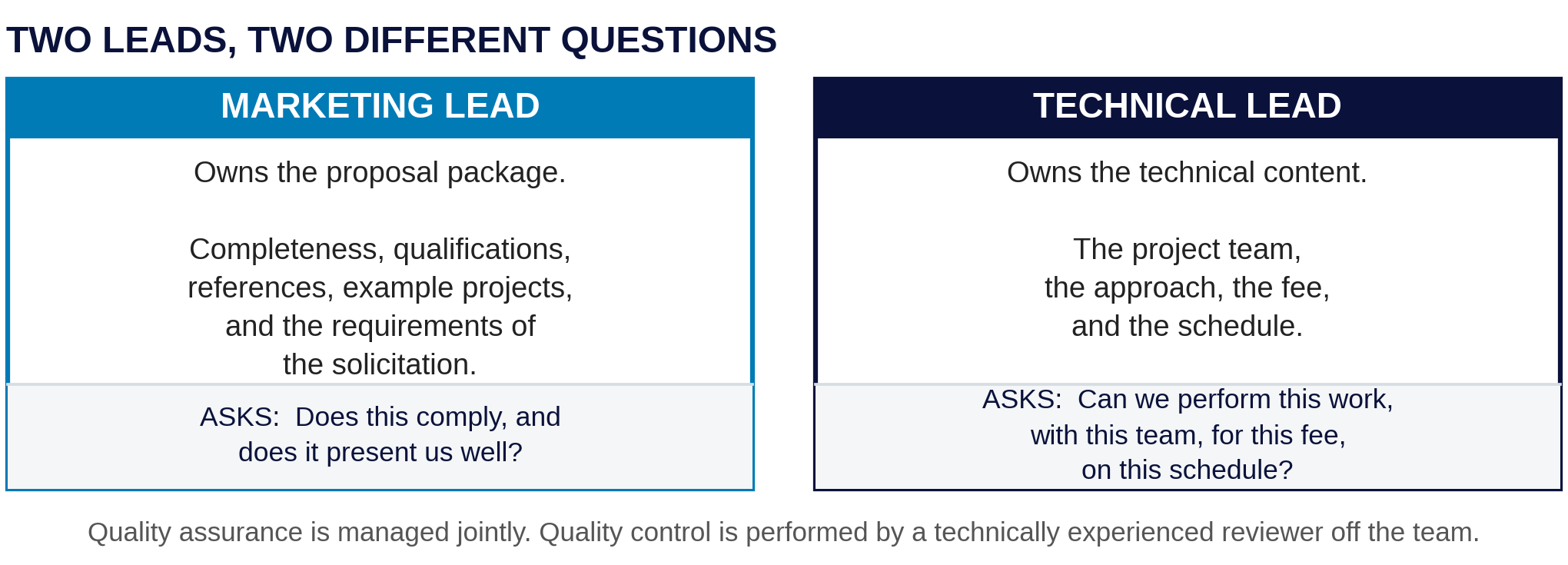
The Marketing Lead and the Technical Lead together manage quality assurance, and a technically experienced staff member outside the proposal team performs , independent of the people who prepared the submission.
1.3.2.2 Additional pursuit team roles
Marketing staff prepare the cover letter, the personnel and experience sections, the qualifications, and the forms.
Key marketing roles include the following:
- The ,
- The ,
- The , and
- The , who marks the Go on the proposal calendar so our firm can see and manage every proposal in production.
Three technical roles prepare the approach, the scope, the schedule, and the fee:
- The project manager,
- The Technical Lead, named on every pursuit with a backup, and
- The , who reviews contract language, terms and conditions, and insurance requirements.
Additional pursuit team roles also include:
- The , who reviews the proposal before it leaves our firm, and
- The , an individual listed on the current .
Some of these roles may be shared by one person.
1.3.3 Opening the opportunity in Deltek Vantagepoint
Every opportunity is entered into our , whether the work begins next month or a year from now. Accurate opportunity data is critical to correctly estimating our firm’s future revenue, which is a metric our firm uses to evaluate overall company financial health.
1.3.3.1 How the opportunity is created
Someone opens a project opportunity in Vantagepoint. If the pursuit requires marketing support, someone completes the in , which reaches Marketing after submission. Deltek Vantagepoint then updates the to “Proposal” and creates a number, linked to the , that tracks the pursuit cost.
Four confirmations then follow:
- The opportunity goes on the as a Go,
- The registers in the client or portal where required,
- The Marketing Lead sends the contract to for review wherever it includes contract language or insurance requirements, and
- The Marketing Lead confirms how the client issues , watches for them, and distributes them to the team.
1.3.3.2 What the record contains
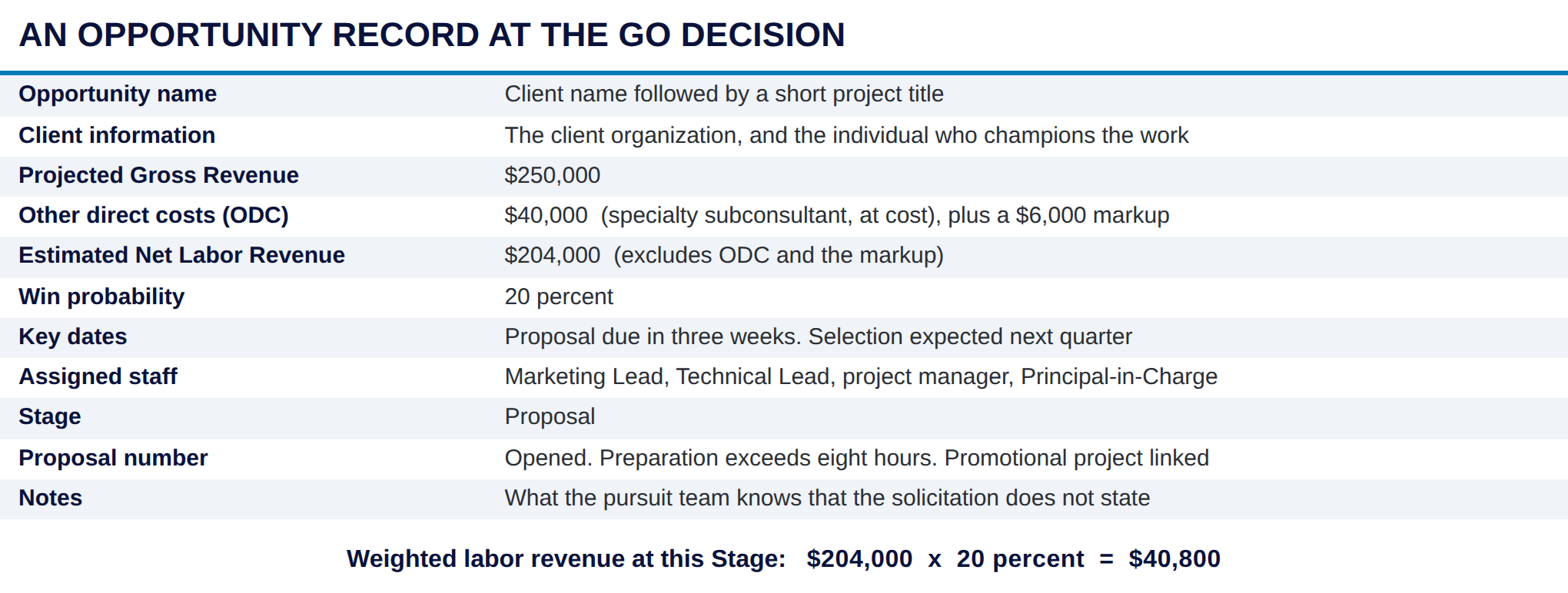
Once created, the contains the following information:
- The opportunity name, meaning client name and short title,
- The organization, meaning the Weston & Sampson entity, office and discipline
- The client information,
- The , including (ODC),
- The , excluding ODC and any on them,
- The ,
- The key proposal and project dates,
- The assigned staff, if known,
- The Stage,
- Whether to open a , and
Any notes to share.
A proposal number tracks the cost of pursuing the work, and one is typically opened for a proposal estimated to require more than eight hours.
1.3.3.3 Stage and the proposal number
The Stage field records the current state of a pursuit. We use Stage to describe where the proposal sits in its journey from Go/No-Go to Award. The stage names are as follows:
- Lead. An early stage potential project or client, not yet a qualified project with assumed revenue and scope of services. Apply no win probability at this Stage.
- Opportunity. A lead that has been qualified and deemed worth pursuing. An opportunity is a defined project with weighted labor revenue and estimated start and completion dates.
- Proposal. Our firm has recorded a and is preparing a submission. Set this Stage when the Go/No-Go form is complete and the opportunity has an Estimated and a win probability.
- No-Go. Our firm has declined the pursuit, or the client has selected another firm. Set this Stage as soon as either occurs. An opportunity that is over and still open overstates the revenue projection.
- . The client has canceled the work, or the project did not proceed.
- . The client has selected Weston & Sampson to perform the work (100% probability of win) but the project has not yet been opened.
1.3.4 Weighted labor revenue, the forecast the record produces
As future projects move through the , our confidence that each opportunity will be awarded to us increases or decreases based on what we learn as we approach award. Our firm measures that confidence with a applied first at the Opportunity and updated through the Proposal stage.
Each opportunity therefore carries these two figures:
- , an opportunity's fee target less and any on them, and
- A win probability, measured in percent and estimated by the project manager.
These two figures combine to produce , the part of Estimated our firm can plan on, calculated as shown below.
Estimated Net Labor Revenue × win probability = weighted labor revenue
A win probability is the project manager's subjective estimate, between 0 and 100 percent, of how likely Weston & Sampson is to convert an opportunity into signed work, and it is affected by many factors including but not limited to:
- ,
- Teaming,
- The qualifications of the proposed team,
- The client relationship,
- The competition, and
- Proximity to the work.
The project manager revises the win probability as more information becomes available, at each opportunity stage, and at least monthly, and our firm combines the weighted labor revenue with to predict future economic conditions.
Estimate a win probability with care, because weighted labor revenue determines our firm's revenue projection. Update revenue, win probability, and schedule in Deltek Vantagepoint as new information becomes available, every month, and at every stage change.
1.3.4.1 An example
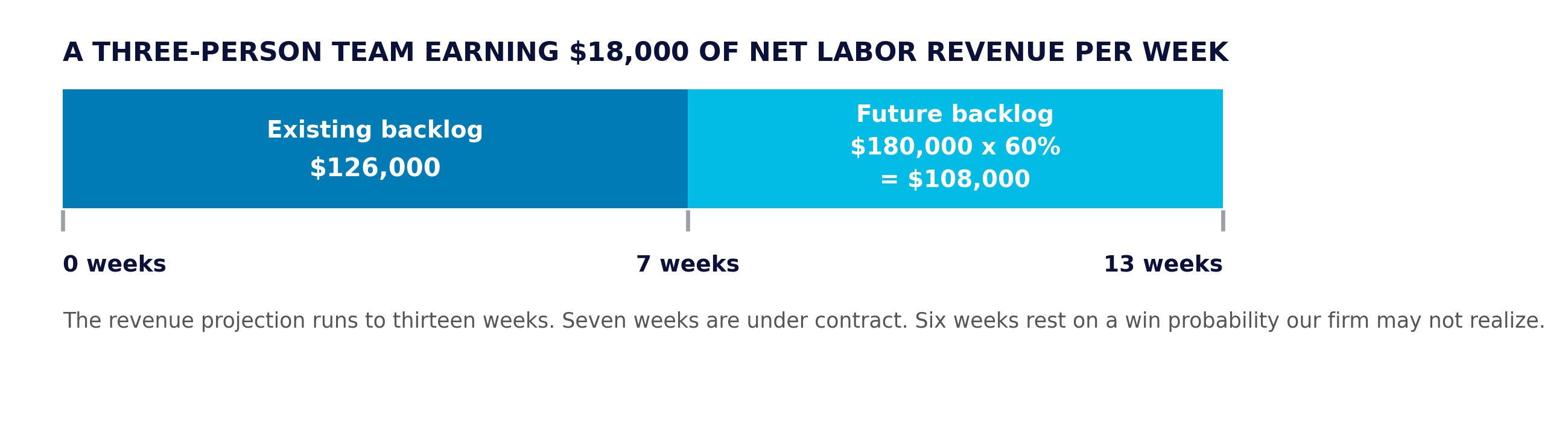
Consider a three-person environmental team that earns approximately $18,000 of Net Labor Revenue per week. The team currently holds $126,000 of existing , the Net Labor Revenue remaining on current contracts. Dividing that backlog by the team's weekly Net Labor Revenue converts it into weeks of work, as shown below.
$126,000 of existing backlog ÷ $18,000 per week = 7 weeks
Weston & Sampson would say this team has “7 weeks of backlog.”
The client then requests that Weston & Sampson submit a proposal for a Phase Two site assessment valued at $180,000. The project manager enters the potential future work as an opportunity with no other direct costs and an Estimated Net Labor Revenue of $180,000. The project manager estimates a 60 percent win probability, which produces the weighted labor revenue shown below.
$180,000 Estimated Net Labor Revenue × 0.60 = $108,000 of weighted labor revenue
Weighted labor revenue for work our firm has not yet won is called . Dividing this new future backlog by the team's weekly Net Labor Revenue converts it into six additional weeks of future work, as shown below.
$108,000 of weighted labor revenue ÷ $18,000 per week = 6 weeks
Six weeks of future backlog plus seven weeks of existing backlog produce a thirteen-week , with six of those weeks dependent on a win probability the project manager estimated, as shown in the figure below.
Accurate Estimated Net Labor Revenue and win probabilities sustain our firm’s performance. These critical planning inputs forecast future economic conditions against which we make critical business decisions about individual team staffing levels, workload, scheduling, and whether we hire, hold current staffing, or re-assign people.
Remember: Weighted labor revenue is Estimated Net Labor Revenue multiplied by the win probability. The ODC markup is not multiplied by the win probability, and Weston & Sampson adds only weighted labor revenue to existing backlog to create a composite picture of likely future conditions, and plans staffing and hiring against the total.
1.3.5 Keeping the record current
Update each monthly and at every change. Keep , , and start and completion dates current and accurate. Custom Vantagepoint search queries allow a project manager to list every opportunity assigned to them, making open opportunities easy to find and sort.
When pursuit conditions change, update these six entries:
- Stage, which shows where the opportunity stands today,
- and , if the conversation changed the scope or fee,
- Win probability,
- Project Start and completion dates as well as key proposal dates,
- Assigned Weston & Sampson staff, and
- Notes on the client’s stated outcome, risks, and other parties.
Win probability often changes the most during the pursuit stage and has the greatest influence on an opportunity’s value to our firm.
For example, an opportunity with $204,000 in Estimated Net Labor Revenue at a 30 percent win probability produces $61,200 in weighted labor revenue. If new information raises the probability to 55 percent, the increases to $112,200, a significant change. A single conversation can uncover the information that justifies that adjustment if the client references any key information that influences our confidence, such as:
- Client identifies a challenge our firm can solve,
- Client names a risk our experience removes,
- Client confirms a budget range that is within our firm’s fee target, and
- Client reveals something the competing firms do not know.
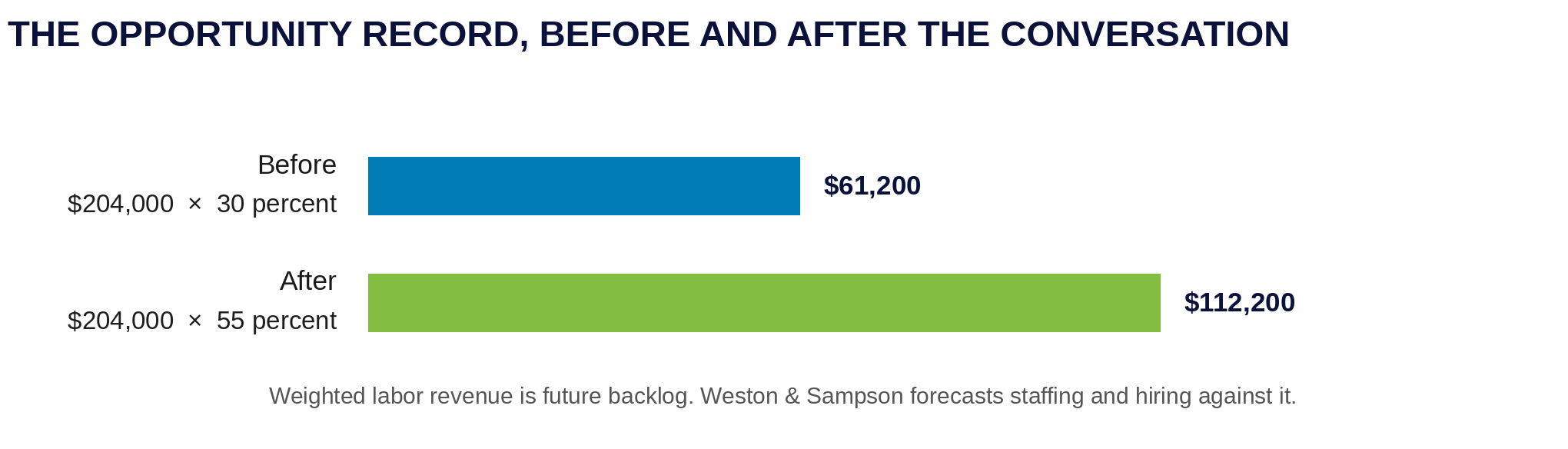
The weighted labor revenue of each opportunity feeds the future . The project start and completion dates place that weighted labor revenue in time, so the forecast shows when the work will occur.
You raise a win probability from 30 percent to 55 percent after a pre-proposal conversation. What evidence supports that change, and what does not?
Four answers support the change, in that the client named a driver our firm can solve, named a risk our experience removes, confirmed a budget range, and stated something the competing firms do not know. The conduct of the meeting itself supports none of it.
Open Deltek Vantagepoint and find the oldest opportunity your name is tagged to and decide whether its win probability and key dates are still accurate.
Remember: An opportunity that no one updates remains in the revenue projection at its last recorded figures. Keep it current to keep our firm’s future revenue picture accurate.
1.3.6 Summary
A assigns the pursuit team and creates an Opportunity Record in that captures the opportunity’s ownership, , revenue, , dates, staffing, and proposal requirements. Project managers must update that record whenever conditions change, and at least monthly, because its weighted labor revenue affects firmwide staffing, workload, and hiring decisions.
With the opportunity documented and the pursuit team established, Week 4 explains how the turns that information into a coordinated plan for developing and submitting the proposal.
Remember
- A Go decision starts the work of the pursuit and identifies roles that will support and organize that work. Section 1.3.1
- Weighted labor revenue is Estimated Net Labor Revenue multiplied by the win probability. The ODC markup is not multiplied by the win probability, and Weston & Sampson adds only weighted labor revenue to existing backlog to create a composite picture of likely future conditions, and plans staffing and hiring against the total. Section 1.3.4
- An opportunity that no one updates remains in the revenue projection at its last recorded figures. Keep it current to keep our firm’s future revenue picture accurate. Section 1.3.5