

PROJECT MANAGEMENT 101 AT WESTON & SAMPSON
MODULE 1 · WEEK 1
THE PURSUIT, FROM LEAD TO AWARD
Approximate reading time: 12 minutes
Module 0 established what Weston & Sampson sells and the economic model that governs our firm’s performance. Week 1 applies that model to the pursuit, the period before a project exists.
This lesson covers four subjects:
The pursuit, from lead through opportunity, Go/No-Go, and proposal to award.
What a pursuit costs our firm, and what our firm’s deliberate process protects.
Client intelligence, and how prepositioning and value discovery build it.
The remaining weeks of Module 1 apply this material to actual pursuit decisions.
Decisions made during a pursuit set the fee, the schedule, and the staffing the project manager will later deliver the project against.
MODULE 1 PURPOSE AND SCOPE
Module 1 covers the pursuit, the period before a project exists. Participants learn how Weston & Sampson identifies, evaluates, prices, and records an opportunity. They also learn how those decisions affect value for the client and for our firm. Three companies make up Weston & Sampson, and this course addresses the engineering company only.
WHERE THIS FITS
Module 0 · The Business of Weston & Sampson
Module 1 · Project Pursuit
Week 1 · The Pursuit, from Lead to Award (you are here)
Week 2 · The Go/No-Go Decision
Week 3 · Pursuit Roles and the Opportunity Record
Week 4 · The Proposal Kickoff Meeting
Module 2 · Scope
Module 3 · Schedule
Module 4 · Budgeting and Project Economics
Lesson objectives
After completing this lesson, a project manager will be able to:
- Describe the pursuit process in sequence, from lead through opportunity, Go/No-Go, and proposal to award, and explain why their entry point into the project determines their influence.
- State what a pursuit costs our firm and name the three things a deliberate pursuit process protects.
- Define prepositioning, and name four ways a project manager contributes to it while delivering work.
1.1.1 From lead to award
Our firm identifies, evaluates, and work before any project team charges an hour to it. That sequence, from lead through proposal, is called the pursuit.
Five terms are defined across the pursuit, from lead through award:
- Lead, the first part of a pursuit at which our firm is developing business relationships, but no formal project exists.
- Opportunity, a lead the client has validated as a project, with a revenue expectation, a , and a schedule.
- Go/No-Go, the formal process our firm uses to pursue (“Go”) or decline (“No-Go”) an opportunity.
- Proposal, our firm's submission that sets the scope, schedule, and financial terms for a project, either formal such as in response to a Request for Proposal (), or informal such as a letter proposal.
- Award, the official notice where the client selects Weston & Sampson and our firm opens the project with a chargeable project number.
Those five terms describe one continuous process, the Initiating Process, as shown in the figure below.
The Initiating Process
Assumptions accumulate at every step. The project team inherits, verifies, or revises them.
Each of the pursuit adds and conditions that shape the future project environment, and the stage at which the project manager becomes involved in the determines the nature of that involvement. A project manager present at the opportunity stage can influence those conditions, while a project manager who arrives at award inherits conditions others have set. Where possible, project managers should advocate for the earliest reasonable involvement in the Initiating Process, as that allows them the greatest opportunity to influence and shape the project conditions they will later operate within.
Think of a project you inherited after award. Which assumption about scope, fee, schedule, or staffing would you have argued with, had you been present when the pursuit team established it?
A project manager who joins at award tests assumptions already made, and naming the assumption that would have been changed is the case to take to business development for the next pursuit.
Remember: Each stage of the Initiating Process adds assumptions and conditions, and the earliest possible involvement gives the project manager the greatest influence over the conditions they will later work under.
1.1.2 What a pursuit costs our firm
Most of Weston & Sampson’s pursuit time and associated cost is performed at risk. In 2024, the on a proposal spent 35 hours on average, and large or complex proposals can require hundreds of hours across several disciplines. Work that was never a fit for our firm produces neither nor a reference project. To maintain focus on the optimal opportunities and prevent unnecessary investment into low value opportunities, the Go/No-Go process requires the project manager and their team to evaluate each project against specific criteria and support that evaluation with evidence.
Remember: Proposal hours are indirect labor. Our firm pays for them whether or not it wins the work. The Go/No-Go process is designed to prevent unnecessary investment into low value opportunities.
1.1.3 What a deliberate process protects
Our firm runs a deliberate pursuit process to protect critical resources that cannot be easily replaced. In this section, we review how the pursuit process intersects with:
- The critical resources a pursuit spends before any client pays for them,
- The operational discipline our firm plans and staffs against, and
- The limited availability of the expertise the work depends on.
1.1.3.1 Critical resources
Proposal hours belong to the same technical staff who deliver billable work, so an hour spent on a proposal is an hour not charged to a project. A pursuit our firm should have declined costs those hours twice, once in to chase the pursuit and once in the billable time it displaced from active projects.
The Go/No-Go process, covered in Week 2, is the control our firm applies to that spending. Most of the industry applies the same control. The Go/No-Go process is the structured decision-making filter we pass every opportunity through to ensure it fits our firm’s goals. The process is designed to maintain our firm’s focus on winnable pursuits while ensuring we do not allocate resources to projects that are not good fits for our staff.
Remember: Proposal hours come out of the same staff who deliver billable work, so a pursuit our firm should have declined costs those hours twice.
1.1.3.2 Operational discipline
A pursuit produces data before it produces revenue, and our firm plans against that data.
Each opportunity carries at least two figures:
- , an opportunity's fee target less and any on them, and
- A , measured in percent and estimated by the project manager.
These two figures combine to produce , the part of Estimated our firm can plan staffing against.
Estimated Net Labor Revenue X Win Probability = Weighted labor revenue
Our firm combines weighted labor revenue with to predict future economic conditions, then commits staffing, hiring, and reassignment decisions against that prediction. Disciplined recording of these two numbers across the pursuit process is essential to our firm’s planning activities.
Think of a pursuit in which the win probability proved to be wrong. What was committed while that estimate was pending?
An inflated win probability commits our firm against revenue that may not arrive, leaving direct labor, overhead, and the project profit target uncovered. An understated win probability hides a staffing need our firm could have planned for.
Remember: A win probability is a critical planning input that predicts our firm’s future economic conditions, and our firm commits staffing and hiring decisions against it.
1.1.3.3 The limited availability of our expertise
Our firm sells the time of experienced technical personnel, and that time is the scarcest input in a pursuit.
often manage multiple opportunities during the same response period. When two pursuits require the same specialist within the same two weeks, they compete for that person’s time, regardless of each pursuit’s individual value. Marketing and proposal staff are also in high demand, and their availability is limited. A deliberate process brings that competition into view before our firm commits the hours.
Remember: Our firm can fund more pursuits than it can staff, so the pursuit process protects the availability of the people the work depends on.
1.1.4 Client intelligence and prepositioning
is the firm’s working knowledge of a client before a pursuit becomes formal. It includes what the client values, what problems they are trying to solve, how they make decisions, who influences those decisions, what they expect from a consultant, and what work may be coming next.
That knowledge should not be assembled for the first time after an drops. Weston & Sampson builds stronger pursuit positions when client intelligence is gathered continuously, through a structured process that captures what each project, meeting, issue, compliment, complaint, planning conversation, and relationship touchpoint teaches us about the client.
Remember: The strongest pursuit position is built before the pursuit drops, when the firm already has a documented understanding of the client’s priorities, expectations, decision makers, and future needs.
Project Managers play a central role because they often have the most regular contact with the client during active delivery. They can observe what the client praises, escalates, questions, delays, or prioritizes; ask about upcoming projects and challenges; recognize where Weston & Sampson can add value; and record those observations for Client Managers, Business Development staff, and future pursuit teams.
is the deliberate use of that intelligence to strengthen the firm’s position before a solicitation is released. It turns scattered client observations into a practical understanding of what the client is likely to buy, why the work matters, how the client will judge value, and which questions still need to be answered.
When a pursuit begins, the team should not be starting from a blank page. Its first step is to consolidate the firm’s existing client intelligence, distinguish facts from , identify gaps that could affect the approach, fee, schedule, or team, and close those gaps through focused client conversations where the solicitation rules permit.
1.1.5 The question list and the client conversation
Once a pursuit becomes active, the team should convert the firm’s existing into a disciplined . The purpose is not to start learning about the client from scratch, but to organize what the firm already knows, test what it only assumes, and identify the questions that must be answered before the team commits to an approach, fee, schedule, or staffing plan.
- What we know firsthand, from the client or the solicitation,
- What we assume, probable and unconfirmed with the client, and
- What we must ask, where the answer changes the approach, the fee, or the team.
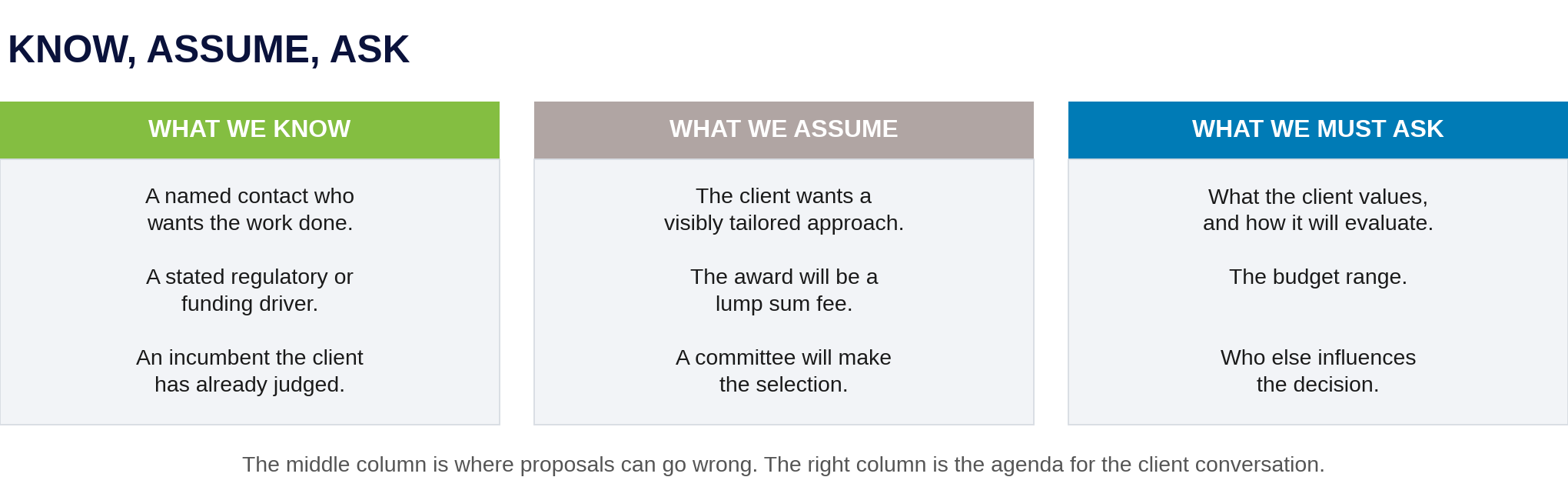
Where the solicitation permits, the pursuit team uses the third column to guide a focused client conversation. That conversation should close the most important intelligence gaps, verify the that affect pursuit strategy, and deepen the team’s understanding of what the client is buying.
The team should listen for two kinds of expectations.
describe what the work must achieve and are often stated in the solicitation.
describe how the client expects the work to be managed, communicated, and supported. These expectations are often less visible, but they can distinguish Weston & Sampson when the proposal shows the client that we understand how they want the project delivered.
Common experience points include:
- How often the client hears from the project manager,
- Who attends the client meetings and public presentations, and who presents,
- How the client learns about a problem, and how quickly,
- Whether the client’s own staff can defend the work without calling our firm.
A team that discovers both performance and experience expectations can connect its scope, staffing, fee, and proposal message to what the client values most.
Think of a client who chose Weston & Sampson over a lower fee. What did that client tell you afterward about why?
Whatever the client named is a performance or experience expectation our firm met and the competitor did not, and neither appeared in the fee.
Remember: An assumption is a statement about the pursuit that the team has not confirmed with the client.
A is any deliberate contact with the client before the response is written. Its purpose is to turn the firm’s working knowledge into pursuit intelligence:
- What problem the client is solving,
- What outcomes matter most,
- What constraints must be respected, and
- What value the proposal must communicate.
That contact may take several forms:
- A telephone call with the ,
- A question at a , or a site visit,
- A written question during the , and
- A relationship established before the solicitation.
This continuous intelligence-building matters because the Go/No-Go Form 2025 awards points for early client contact on four counts:
- Knowledge of the project before the solicitation was released,
- An existing relationship with the client,
- A role in writing the , and
- A basis for distinguishing our firm from its competition.
The better the team understands the client’s outcomes, risks, and decision drivers before writing the proposal, the better it can define value in terms the client is willing to support.
Because the conversation is usually short, four items should be prepared in advance:
- The highest-value questions, drawn from what the team does not yet know and ranked by how much each answer could affect the approach, fee, schedule, or team.
- The wording of each question, using open prompts that invite the client to describe outcomes, consequences, preferences, and concerns.
- The origin of the opportunity, because a client who approached Weston & Sampson may already have identified a preferred solution, concern, or decision path.
- The procurement limits that govern contact, since each client and solicitation may restrict who can communicate, what can be discussed, and when questions must be submitted.
The team should describe Weston & Sampson’s qualifications, team, and approach only after the client has described the problem, the desired outcome, and the constraints that matter most.
The people who represent Weston & Sampson should be selected based on the intelligence the conversation is intended to confirm or gather:
- The , who participates in pre-proposal conversations and is responsible for the approach, the scope, the fee, and the schedule,
- The Client Manager or the , whose agreement to support the pursuit the requires,
- A discipline or practice leader who will ultimately “own” the project in their discipline and where the request for proposals extends into a practice outside the Technical Lead’s own, and
- A technical specialist, where the client’s underlying problem is specialized and the client has raised it.
Two conditions keep the conversation useful and ensure the intelligence reaches the full pursuit team:
- Keep the group small enough that the client speaks more than our participants do, and
- Brief every person who did not attend, since the proposal team acts on what the client stated.
1.1.6 Summary
Weston & Sampson’s pursuit process moves an opportunity from lead through Go/No-Go, proposal, and award while establishing the scope, fee, schedule, and staffing conditions the project team will work under. Early project manager involvement, accurate opportunity data, and continuous help the firm understand what the client values, test critical , and shape a stronger pursuit. Because proposal work consumes nonbillable time from scarce technical staff, the process must protect the firm’s resources, operational plans, and expertise.
That makes project selection the next critical decision. The Go/No-Go process determines whether an opportunity is valuable and winnable enough to justify the firm’s investment and whether Weston & Sampson can deliver it successfully under the proposed conditions.
Remember
- Each stage of the Initiating Process adds assumptions and conditions, and the earliest possible involvement gives the project manager the greatest influence over the conditions they will later work under. Section 1.1.1
- Proposal hours are indirect labor. Our firm pays for them whether or not it wins the work. The Go/No-Go process is designed to prevent unnecessary investment into low value opportunities. Section 1.1.2
- Proposal hours come out of the same staff who deliver billable work, so a pursuit our firm should have declined costs those hours twice. Section 1.1.3
- A win probability is a critical planning input that predicts our firm’s future economic conditions, and our firm commits staffing and hiring decisions against it. Section 1.1.3
- Our firm can fund more pursuits than it can staff, so the pursuit process protects the availability of the people the work depends on. Section 1.1.3
- The strongest pursuit position is built before the pursuit drops, when the firm already has a documented understanding of the client’s priorities, expectations, decision makers, and future needs. Section 1.1.4
- An assumption is a statement about the pursuit that the team has not confirmed with the client. Section 1.1.5